
M3 January 2005 Q2
2.
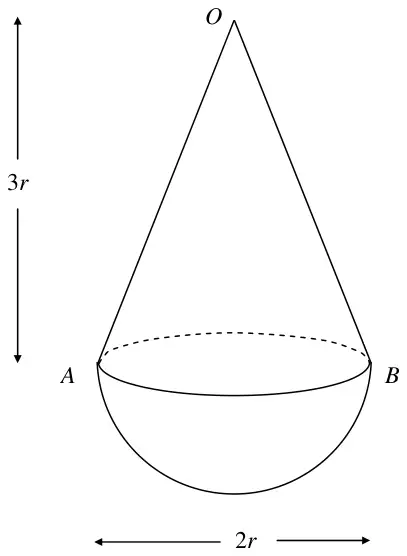
A child’s toy consists of a uniform solid hemisphere, of mass \(M\) and base radius \(r\), joined to a uniform solid right circular cone of mass \(m\), where \(2m < M\). The cone has vertex \(O\), base radius \(r\) and height \(3r\). Its plane face, with diameter \(AB\), coincides with the plane face of the hemisphere, as shown in Figure 1.
(a) Show that the distance of the centre of mass of the toy from \(AB\) is \[\frac{3(M-2m)}{8(M+m)}r.\] (5)
The toy is placed with \(OA\) on a horizontal surface. The toy is released from rest and does not remain in equilibrium.
(b) Show that \(M > 26m\). (4)
| Scheme | Marks |
|---|---|
| \(\dfrac{3r}{4}\ ;\ \dfrac{3r}{8}\) | B1 ; B1 |
| \(-m \cdot \dfrac{3r}{4} + M \cdot \dfrac{3r}{8} = (m+M)\bar{x}\) | M1 A1 |
| \(\dfrac{3r(M-2m)}{8(M+m)} = \bar{x}\) * | A1 |
| (5) |
| Scheme | Marks |
|---|---|
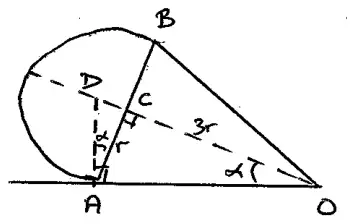
| \(CD = r\tan\alpha = r \times \left(\dfrac{r}{3r}\right) = \dfrac{1}{3}r\) | M1 A1 |
| No equil\(^\text{m}\) \(\Rightarrow \bar{x} > CD\) | |
| \(\dfrac{3r(M-2m)}{8(M+m)} > \dfrac{r}{3}\) | M1 |
| \(9(M-2m) > 8(M+m)\) | |
| \(M > 26m\) * | A1 |
| (4) | |
| (9 marks) |