
M3 June 2013 Q5
5.
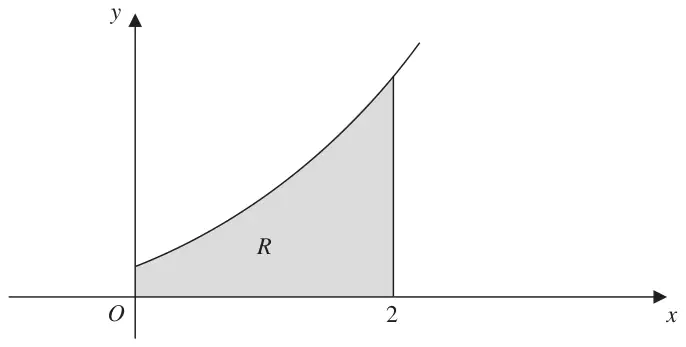
The shaded region \(R\) is bounded by the curve with equation \(y = (x + 1)^2\), the \(x\)-axis, the \(y\)-axis and the line with equation \(x = 2\), as shown in Figure 3. The region \(R\) is rotated through \(2\pi\) radians about the \(x\)-axis to form a uniform solid \(S\).
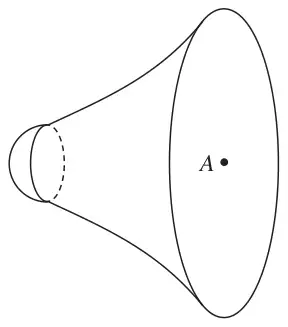
A uniform solid hemisphere is fixed to \(S\) to form a solid \(T\). The hemisphere has the same radius as the smaller plane face of \(S\) and its plane face coincides with the smaller plane face of \(S\), as shown in Figure 4. The mass per unit volume of the hemisphere is 10 times the mass per unit volume of \(S\). The centre of the circular plane face of \(T\) is \(A\). All lengths are measured in centimetres.
| Scheme | Marks |
|---|---|
| \(V = \displaystyle\int_0^2 \pi y^2\,\mathrm{d}x = \pi\int_0^2 (x + 1)^4\,\mathrm{d}x\) | M1 |
| \(= \pi\left[\dfrac{1}{5}(x + 1)^5\right]_0^2\) | A1 |
| \(= \dfrac{1}{5}\pi\left[3^5 - 1\right]\ \ \ \left(= \dfrac{242\pi}{5}\right)\) | M1 |
| \(\displaystyle\int_0^2 \pi y^2 x\,\mathrm{d}x = \pi\int_0^2 x(x + 1)^4\,\mathrm{d}x\) | M1 |
| \(= \pi\left[\dfrac{x(x + 1)^5}{5}\right]_0^2 - \pi\displaystyle\int_0^2 \frac{(x + 1)^5}{5}\,\mathrm{d}x,\ \ = \frac{2 \times 3^5\pi}{5} - \pi\left[\frac{(x + 1)^6}{30}\right]_0^2\) | A1 |
| \(\left[\dfrac{2 \times 3^5}{5} - \dfrac{3^6}{30} + \dfrac{1}{30}\right]\pi\ \ \ (= 72.933\ldots\pi)\) | M1 |
| ALT: by expanding \(= \pi\displaystyle\int_0^2 \left(x^5 + 4x^4 + 6x^3 + 4x^2 + x\right)\mathrm{d}x\) | |
| \(= \pi\left[\dfrac{x^6}{6} + \dfrac{4}{5}x^5 + \dfrac{6}{4}x^4 + \dfrac{4}{3}x^3 + \dfrac{1}{2}x^2\right]_0^2\) | M1A1 |
| \(= \pi\left[\dfrac{2^6}{6} + \dfrac{4}{5} \times 2^5 + \dfrac{6}{4} \times 2^4 + \dfrac{4}{3} \times 2^3 + \dfrac{1}{2} \times 2^2\right]\) | M1 |
| OR by subst: \(\pi\displaystyle\int_1^3 (u - 1)u^4\,\mathrm{d}u,\ = \pi\left[\frac{u^6}{6} - \frac{u^5}{5}\right]_1^3,\ = \pi\left[\frac{3^6}{6} - \frac{3^5}{5} - \left(\frac{1}{6} - \frac{1}{5}\right)\right]\) | M1A1M1 |
| \(\bar{x} = \dfrac{\pi\left[\dfrac{2 \times 3^5}{5} - \dfrac{3^6 - 1}{30}\right]}{\dfrac{242\pi}{5}}\) OR \(\dfrac{\pi\left[\dfrac{2^6}{6} + \dfrac{4 \times 2^5}{5} + \dfrac{6 \times 2^4}{4} + \dfrac{4 \times 2^3}{3} + \dfrac{2^2}{2}\right]}{\dfrac{242\pi}{5}},\ = 1.5068\) | M1, A1 |
| (8) |
Notes
NB: Some candidates will omit \(\pi\) throughout (as they know it cancels). In such cases award all marks if earned. If \(\pi\) is omitted from one integration only but then appears in the result of that integration at the last stage or is then omitted from the second integration, all marks can be gained. But if omitted from one integration, including the last stage, and included with the other mark strictly according to the MS.
M1 for using \(V = \displaystyle\int_0^2 \pi y^2\,\mathrm{d}x = \pi\int_0^2 (x + 1)^4\,\mathrm{d}x\) - limits not needed and attempting the integration by inspection or expansion (algebra must be seen)
A1 for correct integration - limits not needed
M1 for substituting the correct limits into their integrated function - no need to simplify
M1 for attempting to integrate \(\displaystyle\int_0^2 \pi y^2 x\,\mathrm{d}x = \pi\int_0^2 x(x + 1)^4\,\mathrm{d}x\) - limits not needed - by parts. This mark can be awarded once the integral has been expressed as the difference of an appropriate integrated function and an integral
A1 for correct, complete integration \(\pi\left[\dfrac{x(x + 1)^5}{5}\right]_0^2 - \pi\left[\dfrac{(x + 1)^6}{30}\right]_0^2\) or \(\dfrac{2 \times 3^5\pi}{5} - \pi\left[\dfrac{(x + 1)^6}{30}\right]_0^2\) Limits not needed
M1 for substituting the correct limits into their integrated function - no need to simplify
Alternative methods for \(\displaystyle\int_0^2 \pi y^2 x\,\mathrm{d}x = \pi\int_0^2 x(x + 1)^4\,\mathrm{d}x\)
M1 for expanding and integrating or making a suitable substitution and attempting the integration - limits not needed
A1 for correct integration - limits not needed
M1 for substituting the correct limits into their integrated function - no need to simplify
M1 for using \(\bar{x} = \dfrac{\displaystyle\int \pi y^2 x\,\mathrm{d}x}{\displaystyle\int \pi y^2\,\mathrm{d}x}\) Their integrals need not be correct.
A1cao for \(\bar{x} = 1.5068\ldots\) Accept 1.5, 1.51 or better or \(\dfrac{547}{363}\)
| Scheme | Marks | ||||||||||||
|---|---|---|---|---|---|---|---|---|---|---|---|---|---|
| B1ft on \(S\) B1ft on \(S\) | ||||||||||||
| \(\dfrac{20}{3} \times \dfrac{19}{8} + \dfrac{242}{5} \times 0.493 = \left(\dfrac{20}{3} + \dfrac{242}{5}\right)\bar{x}\) | M1A1ft | ||||||||||||
| \(\bar{x} = 0.7208\ldots\) cm (awrt 0.72) | A1 | ||||||||||||
| (5) | |||||||||||||
| (13 marks) |
Notes
B1ft for correct mass ratio, follow through their volume for \(S\) need \(\pi\) now
B1ft for correct distances, follow through their distance for \(S\), but remember it must be 2 - answer from (a) if working from \(A\). Distances from the common face are \(-\frac{3}{8}\), ans from (a), \(\bar{x}\) Distances from other end are \(\frac{5}{8}\), 1 + ans from (a), \(\bar{x}\)
M1 for a dimensionally correct moments equation
A1ft for a fully correct moments equation, follow through their distances and mass ratio
A1cao for 0.7208...Accept 0.72 or better (Exact is \(\dfrac{1191}{1652}\))