
M3 January 2009 Q6
6.
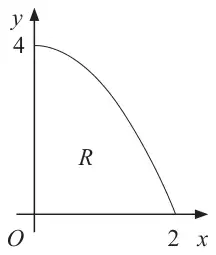
The region \(R\) is bounded by part of the curve with equation \(y = 4 - x^2\), the positive \(x\)-axis and the positive \(y\)-axis, as shown in Figure 3. The unit of length on both axes is one metre. A uniform solid \(S\) is formed by rotating \(R\) through 360\(^\circ\) about the \(x\)-axis.
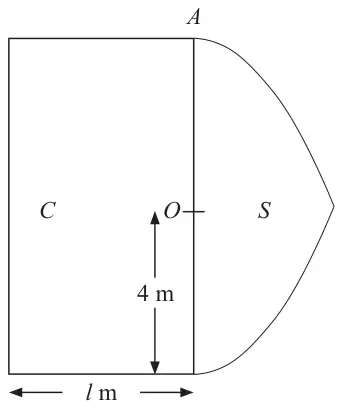
Figure 4 shows a cross section of a uniform solid \(P\) consisting of two components, a solid cylinder \(C\) and the solid \(S\). The cylinder \(C\) has radius 4 m and length \(l\) metres. One end of \(C\) coincides with the plane circular face of \(S\). The point \(A\) is on the circumference of the circular face common to \(C\) and \(S\). When the solid \(P\) is freely suspended from \(A\), the solid \(P\) hangs with its axis of symmetry horizontal.
| Scheme | Marks |
|---|---|
| \(\displaystyle\int y^2\,\mathrm{d}x = \int \left(4 - x^2\right)^2\mathrm{d}x = \int \left(16 - 8x^2 + x^4\right)\mathrm{d}x\) \(= 16x - \dfrac{8x^3}{3} + \dfrac{x^5}{5}\) | M1 A1 |
| \(\left[16x - \dfrac{8x^3}{3} + \dfrac{x^5}{5}\right]_0^2 = \dfrac{256}{15}\) | M1 A1 |
| \(\displaystyle\int xy^2\,\mathrm{d}x = \int x\left(4 - x^2\right)^2\mathrm{d}x = \int \left(16x - 8x^3 + x^5\right)\mathrm{d}x\) \(= 8x^2 - 2x^4 + \dfrac{x^6}{6}\) | M1 A1 |
| \(\left[8x^2 - 2x^4 + \dfrac{x^6}{6}\right]_0^2 = \dfrac{32}{3}\) | M1A1 |
| \(\bar{x} = \dfrac{\int xy^2\,\mathrm{d}x}{\int y^2\,\mathrm{d}x} = \dfrac{32}{3} \times \dfrac{15}{256} = \dfrac{5}{8}\) * | M1 A1 |
| (10) |
Notes
(Corrected from the printed mark scheme: the last line is printed as \(\dfrac{32}{3} \times \dfrac{15}{216}\).)
| Scheme | Marks |
|---|---|
| \(A \times \bar{x} = \left(\pi r^2 l\right) \times \dfrac{l}{2}\) | M1 |
| \(\dfrac{256}{15}\pi \times \dfrac{5}{8} = \pi \times 16l \times \dfrac{l}{2}\) | A1 ft |
| Leading to \(l = \dfrac{2\sqrt{3}}{3}\) accept exact equivalents or awrt 1.15 | M1 A1 |
| (4) | |
| (14 marks) |