
M2 June 2014 Q6
6.
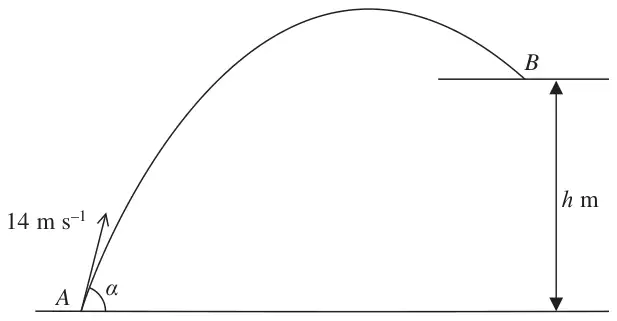
A small ball is projected with speed 14 m s\(^{-1}\) from a point \(A\) on horizontal ground. The angle of projection is \(\alpha\) above the horizontal. A horizontal platform is at height \(h\) metres above the ground. The ball moves freely under gravity until it hits the platform at the point \(B\), as shown in Figure 2. The speed of the ball immediately before it hits the platform at \(B\) is 10 m s\(^{-1}\).
Given that \(\sin\alpha = 0.85\),
| Scheme | Marks |
|---|---|
| Considering energy: \(\dfrac{1}{2}m \times 14^2 = \dfrac{1}{2}m \times 10^2 + mgh\) | M1 A2 |
| \(h = \dfrac{48}{g} = 4.90\) | A1 |
| (4) |
Notes
M1 All terms required. Terms need to be of the correct form but condone sign errors.
A2 -1 each error in the unsimplified equation
A1 Accept \(\dfrac{48}{g}\). Maximum 3 s.f. if they go in to decimals.
alt(a)
| Initial \(v_y = 14\sin\alpha\ \ \ \) Final \(v_y = \sqrt{100 - 14^2\cos^2\alpha}\) | |
| \(100 - 196\cos^2\alpha = 196\sin^2\alpha - 2gh\) | M1A2 |
| \(h = \dfrac{48}{g} = 4.90\) | A1 |
Using \(v^2 = u^2 + 2as\) on the vertical components of speed.
M1A2 -1 each error in the unsimplified equation
A1 Accept in exact form. Maximum 3 s.f. if they go in to decimals.
NB Using \(v^2 = u^2 + 2as\) with 10 and 14 is M0
NB In part (a) they must be solving the general case, not using 0.85. However, the marks in (b) are all available if they solve the specific case in (a).
| Scheme | Marks |
|---|---|
| Vertical distance: \(h = 14\sin\alpha t - \dfrac{1}{2} \times 9.8t^2\) | M1 |
| \(4.9t^2 - 11.9t + h = 0\) | A2 |
| \(t = \dfrac{11.9 \pm \sqrt{11.9^2 - 4 \times 4.9^2}}{9.8}\) | DM1 |
| \(t = 1.903\ldots\) | A1 |
| Horizontal distance: \(x = 14\cos\alpha \times t\) | M1 A1 |
| \(= 14.0\) (m) | A1 |
| (8) | |
| (12 marks) |
Notes
M1 A complete method to find an equation in \(t\). Must involve trig condone sin/cos confusion
A2 Correct in \(h\) or their \(h\). -1 each error
DM1 Solve a 3 term quadratic for \(t\). Needs their value for \(h\) now.
A1 1.9 or better
M1 Method for the horizontal distance. Condone consistent sin/cos confusion
A1 Correct for their positive \(t\)
A1 Accept 14
Alt (b)
| Vertical speed \(= \sqrt{100 - (14\cos\alpha)^2}\ (= 6.75)\) | M1 A2 |
| \(v = u + at = 14 \times 0.85 - 9.8t\ \ \ (-6.75 = 11.9 - 9.8t)\) | DM1 |
| \(t = 1.903\ldots\) | A1 |
| Horizontal distance: \(x = 14\cos\alpha \times t\) | M1 A1 |
| \(= 14.0\) (m) | A1 |
M1 A complete method to find the vertical component of the speed at \(B\).
A2 Correct insimplified. -1 each error.
DM1 Use their vertical component to find \(t\)
A1 1.9 or better
M1 Method for the horizontal distance.
A1 Correct for their positive \(t\)
A1 Accept 14
NB Candidates with a false method leading to 4.9 in (a) score at most M1A1A1DM1A0M1A1A0 if they use their result in (b). This error does not affect the alt (b) approach