
C4 June 2013 Q8
8. With respect to a fixed origin \(O\), the line \(l\) has equation \[\mathbf{r} = \begin{pmatrix}13\\8\\1\end{pmatrix} + \lambda\begin{pmatrix}2\\2\\-1\end{pmatrix}, \text{ where } \lambda \text{ is a scalar parameter.}\]
The point \(A\) lies on \(l\) and has coordinates \((3, -2, 6)\).
The point \(P\) has position vector \((-p\mathbf{i} + 2p\mathbf{k})\) relative to \(O\), where \(p\) is a constant.
Given that vector \(\overrightarrow{PA}\) is perpendicular to \(l\),
Given also that \(B\) is a point on \(l\) such that \(\angle BPA = 45^\circ\),
| Scheme | Marks |
|---|---|
| \(l: \mathbf{r} = \begin{pmatrix}13\\8\\1\end{pmatrix} + \lambda\begin{pmatrix}2\\2\\-1\end{pmatrix}, \quad A(3, -2, 6), \quad \overrightarrow{OP} = \begin{pmatrix}-p\\0\\2p\end{pmatrix}\) | |
| \(\left\{\overrightarrow{PA}\right\} = \begin{pmatrix}3\\-2\\6\end{pmatrix} - \begin{pmatrix}-p\\0\\2p\end{pmatrix} = \begin{pmatrix}3 + p\\-2\\6 - 2p\end{pmatrix}\) or \(\left\{\overrightarrow{AP}\right\} = \begin{pmatrix}-p\\0\\2p\end{pmatrix} - \begin{pmatrix}3\\-2\\6\end{pmatrix} = \begin{pmatrix}-3 - p\\2\\2p - 6\end{pmatrix}\) Finds the difference between \(\overrightarrow{OA}\) and \(\overrightarrow{OP}\). Ignore labelling. Correct difference. | M1 A1 |
| \(\begin{pmatrix}3 + p\\-2\\6 - 2p\end{pmatrix}\bullet\begin{pmatrix}2\\2\\-1\end{pmatrix} = 6 + 2p - 4 - 6 + 2p = 0\) See notes. | M1 |
| \(p = 1\) | A1 cso |
| (4) |
Notes
M1: Finds the difference between \(\overrightarrow{OA}\) and \(\overrightarrow{OP}\). Ignore labelling.
If no “subtraction” seen, you can award M1 for 2 out of 3 correct components of the difference.
A1: Accept any of \(\begin{pmatrix}3 + p\\-2\\6 - 2p\end{pmatrix}\) or \((3 + p)\mathbf{i} - 2\mathbf{j} + (6 - 2p)\mathbf{k}\) or \(\begin{pmatrix}-3 - p\\2\\2p - 6\end{pmatrix}\) or \((-3 - p)\mathbf{i} + 2\mathbf{j} + (2p - 6)\mathbf{k}\)
M1: Applies the formula \(\overrightarrow{PA}\bullet\begin{pmatrix}2\\2\\-1\end{pmatrix}\) or \(\overrightarrow{AP}\bullet\begin{pmatrix}2\\2\\-1\end{pmatrix}\) correctly to give a linear equation in \(p\) which is set equal to zero. Note: The dot product can also be with \(\pm k\begin{pmatrix}2\\2\\-1\end{pmatrix}\). Eg: Some candidates may find
\(\begin{pmatrix}13\\8\\1\end{pmatrix} - \begin{pmatrix}3\\-2\\6\end{pmatrix} = \begin{pmatrix}10\\10\\-5\end{pmatrix}\), for instance, and use this in their dot product which is fine for M1.
A1: Finds \(p = 1\) from a correct solution only.
Note: The direction of subtraction is not important in part (a).
| Scheme | Marks |
|---|---|
| \(|AP| = \sqrt{4^2 + (-2)^2 + 4^2}\) or \(|AP| = \sqrt{(-4)^2 + 2^2 + (-4)^2}\) See notes. | M1 |
| So, \(PA\) or \(AP = \sqrt{36}\) or 6 cao | A1 cao |
| It follows that, \(AB = \text{"}6\text{"}\ \left\{= PA\right\}\) or \(PB = \text{"}6\sqrt{2}\text{"}\ \left\{= \sqrt{2}\,PA\right\}\) See notes. | B1 ft |
| {Note that \(AB = \text{"}6\text{"} = 2\)(the modulus of the direction vector of \(l\)) } | |
| \(\overrightarrow{OB} = \begin{pmatrix}3\\-2\\6\end{pmatrix} \pm 2\begin{pmatrix}2\\2\\-1\end{pmatrix}\) or \(\overrightarrow{OB} = \begin{pmatrix}13\\8\\1\end{pmatrix} - 3\begin{pmatrix}2\\2\\-1\end{pmatrix}\) and \(\overrightarrow{OB} = \begin{pmatrix}13\\8\\1\end{pmatrix} - 7\begin{pmatrix}2\\2\\-1\end{pmatrix}\) Uses a correct method in order to find both possible sets of coordinates of \(B\). | M1 |
| \(= \begin{pmatrix}7\\2\\4\end{pmatrix} \text{ and } \begin{pmatrix}-1\\-6\\8\end{pmatrix}\) Both coordinates are correct. | A1 cao |
| (5) | |
| (9 marks) |
Notes
M1: Uses their value of \(p\) and Pythagoras to obtain a numerical expression for either \(AP\) or \(PA\) or \(AP^2\) or \(PA^2\). Eg: \(PA\) or \(AP = \sqrt{4^2 + (-2)^2 + 4^2}\) or \(\sqrt{(-4)^2 + 2^2 + (-4)^2}\) or \(\sqrt{4^2 + 2^2 + 4^2}\)
or \(PA^2\) or \(AP^2 = 4^2 + (-2)^2 + 4^2\) or \((-4)^2 + 2^2 + (-4)^2\) or \(4^2 + 2^2 + 4^2\)
A1: \(AP\) or \(PA = \sqrt{36}\) or 6 cao or \(AP^2 = 36\) cao
B1ft: States or it is clear from their working that \(AB = \text{"}6\text{"}\ \left\{= \text{their evaluated } PA\right\}\) or
\(PB = \text{"}6\text{"}\sqrt{2}\ \left\{= \sqrt{2}\ (\text{their evaluated } PA)\right\}\).
Note: So a correct follow length is required here for either \(AB\) or \(PB\) using their evaluated \(PA\).
Note: This mark may be found on a diagram.
Note: If a candidate states that \(\left|\overrightarrow{AP}\right| = \left|\overrightarrow{AB}\right|\) and then goes on to find \(\left|\overrightarrow{AP}\right| = 6\) then the B1 mark can be implied.
IMPORTANT: This mark may be implied as part of expressions such as:
\(\{AB =\}\ \sqrt{(10 + 2\lambda)^2 + (10 + 2\lambda)^2 + (-5 - \lambda)^2} = \mathbf{6}\) or \(\left\{AB^2 =\right\}\ (10 + 2\lambda)^2 + (10 + 2\lambda)^2 + (-5 - \lambda)^2 = \mathbf{36}\)
or \(\{PB =\}\ \sqrt{(14 + 2\lambda)^2 + (8 + 2\lambda)^2 + (-1 - \lambda)^2} = \mathbf{6\sqrt{2}}\) or \(\left\{PB^2 =\right\}\ (14 + 2\lambda)^2 + (8 + 2\lambda)^2 + (-1 - \lambda)^2 = \mathbf{72}\)
M1: Uses a full method in order to find both possible sets of coordinates of \(B\):
Eg 1: \(\overrightarrow{OB} = \begin{pmatrix}3\\-2\\6\end{pmatrix} \pm 2\begin{pmatrix}2\\2\\-1\end{pmatrix}\) Eg 2: \(\overrightarrow{OB} = \begin{pmatrix}13\\8\\1\end{pmatrix} - 3\begin{pmatrix}2\\2\\-1\end{pmatrix}\) and \(\overrightarrow{OB} = \begin{pmatrix}13\\8\\1\end{pmatrix} - 7\begin{pmatrix}2\\2\\-1\end{pmatrix}\)
Note: If a candidate achieves at least one of the correct \((7, 2, 4)\) or \((-1, -6, 8)\) then award SC M1 here.
Note: \(\overrightarrow{OB} = \begin{pmatrix}3\\-2\\6\end{pmatrix} - 3\begin{pmatrix}2\\2\\-1\end{pmatrix}\) and \(\overrightarrow{OB} = \begin{pmatrix}3\\-2\\6\end{pmatrix} - 7\begin{pmatrix}2\\2\\-1\end{pmatrix}\) is M0.
A1: For both \((7, 2, 4)\) and \((-1, -6, 8)\). Accept vector notation or \(\mathbf{i}\), \(\mathbf{j}\), \(\mathbf{k}\) notation.
Note: All the marks are accessible in part (b) if \(p = 1\) is found from incorrect working in part (a).
Note: Imply M1A1B1 and award M1 for candidates who write: \(\overrightarrow{OB} = \begin{pmatrix}3\\-2\\6\end{pmatrix} \pm 2\begin{pmatrix}2\\2\\-1\end{pmatrix}\), with little or no earlier working.
Helpful Diagram!
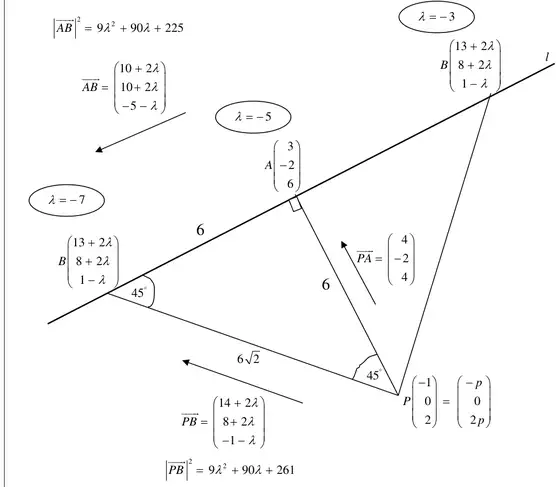
8. (b) Way 2: Setting \(AB = \text{"}6\text{"}\) or \(AB^2 = \text{"}36\text{"}\)
Note: It is possible for you to apply the main scheme for Way 2.
| Scheme | Marks |
|---|---|
| \(\left\{AB = \text{"}6\text{"} \Rightarrow AB^2 = \text{"}36\text{"} \Rightarrow\right\}\quad (10 + 2\lambda)^2 + (10 + 2\lambda)^2 + (-5 - \lambda)^2 = \text{"}36\text{"}\) B1ft could be implied here. | |
| \(9\lambda^2 + 90\lambda + 225 = 36 \Rightarrow 9\lambda^2 + 90\lambda + 189 = 0\) \(\lambda^2 + 10\lambda + 21 = 0 \Rightarrow (\lambda + 3)(\lambda + 7) = 0\) \(\lambda = -3, -7\) | |
| Then apply final M1 A1 as in the original scheme. | ... M1 A1 |
8. (b) Way 3: Setting \(PB = \text{"}6\sqrt{2}\text{"}\) or \(PB^2 = \text{"}72\text{"}\)
Note: It is possible for you to apply the main scheme for Way 3.
| Scheme | Marks |
|---|---|
| \(\left\{PB = \text{"}6\text{"}\sqrt{2} \Rightarrow PB^2 = \text{"}72\text{"} \Rightarrow\right\}\quad (14 + 2\lambda)^2 + (8 + 2\lambda)^2 + (-1 - \lambda)^2 = \text{"}72\text{"}\) B1ft could be implied here. | |
| \(9\lambda^2 + 90\lambda + 261 = 72 \Rightarrow 9\lambda^2 + 90\lambda + 189 = 0\) \(\lambda^2 + 10\lambda + 21 = 0 \Rightarrow (\lambda + 3)(\lambda + 7) = 0\) \(\lambda = -3, -7\) | |
| Then apply final M1 A1 as in the original scheme. | ... M1 A1 |
8. (b) Way 4: Using the dot product formula between \(\overrightarrow{PA}\) and \(\overrightarrow{PB}\), ie: \(\cos 45^\circ = \dfrac{\overrightarrow{PA}\bullet\overrightarrow{PB}}{\left|\overrightarrow{PA}\right|.\left|\overrightarrow{PB}\right|}\)
(You need to be convinced that a candidate is applying this method before you apply the Mark Scheme for Way 4).
| Scheme | Marks |
|---|---|
| \(\overrightarrow{PA}\bullet\overrightarrow{PB} = \begin{pmatrix}4\\-2\\4\end{pmatrix}\bullet\begin{pmatrix}14 + 2\lambda\\8 + 2\lambda\\-1 - \lambda\end{pmatrix} = 56 + 8\lambda - 16 - 4\lambda - 4 - 4\lambda = 36\) | |
| \(\left\{\cos 45^\circ =\right\}\ \dfrac{1}{\sqrt{2}} = \dfrac{36}{6\,\sqrt{9\lambda^2 + 90\lambda + 261}}\) For finding \(\left|\overrightarrow{PA}\right|\) as before. \(\sqrt{36}\) or 6 \(\left|\overrightarrow{PB}\right| = \sqrt{9\lambda^2 + 90\lambda + 261}\) | M1 A1 cao B1 oe |
| \(\dfrac{1}{2} = \dfrac{36}{9\lambda^2 + 90\lambda + 261}\) \(9\lambda^2 + 90\lambda + 261 = 72 \Rightarrow 9\lambda^2 + 90\lambda + 189 = 0\) \(\lambda^2 + 10\lambda + 21 = 0 \Rightarrow (\lambda + 3)(\lambda + 7) = 0\) \(\lambda = -3, -7\) | |
| Then apply final M1 A1 as in the original scheme. | ... M1 A1 |
8. (b) Way 5: Using the dot product formula between \(\overrightarrow{AB}\) and \(\overrightarrow{PB}\), ie: \(\cos 45^\circ = \dfrac{\overrightarrow{AB}\bullet\overrightarrow{PB}}{\left|\overrightarrow{AB}\right|.\left|\overrightarrow{PB}\right|}\)
(You need to be convinced that a candidate is applying this method before you apply the Mark Scheme for Way 5).
| Scheme | Marks |
|---|---|
| \(\cos 45^\circ = \dfrac{1}{\sqrt{2}} = \dfrac{\begin{pmatrix}10 + 2\lambda\\10 + 2\lambda\\-5 - \lambda\end{pmatrix}\bullet\begin{pmatrix}14 + 2\lambda\\8 + 2\lambda\\-1 - \lambda\end{pmatrix}}{\sqrt{9\lambda^2 + 90\lambda + 225}\ \sqrt{9\lambda^2 + 90\lambda + 261}}\) Attempts the dot product formula between \(\overrightarrow{AB}\) and \(\overrightarrow{PB}\). Correct statement with \(\left|\overrightarrow{AB}\right|\) and \(\left|\overrightarrow{PB}\right|\) simplified as shown. Either \(\left|\overrightarrow{AB}\right| = \sqrt{9\lambda^2 + 90\lambda + 225}\) or \(\left|\overrightarrow{PB}\right| = \sqrt{9\lambda^2 + 90\lambda + 261}\) | M1 A1 B1 |
| \(\left\{\cos 45^\circ =\right\}\ \dfrac{1}{\sqrt{2}} = \dfrac{140 + 20\lambda + 28\lambda + 4\lambda^2 + 80 + 20\lambda + 16\lambda + 4\lambda^2 + 5 + 5\lambda + \lambda + \lambda^2}{\sqrt{9\lambda^2 + 90\lambda + 225}\ \sqrt{9\lambda^2 + 90\lambda + 261}}\) | |
| \(\left\{\cos 45^\circ =\right\}\ \dfrac{1}{\sqrt{2}} = \dfrac{9\lambda^2 + 90\lambda + 225}{\sqrt{9\lambda^2 + 90\lambda + 225}\ \sqrt{9\lambda^2 + 90\lambda + 261}}\) | |
| \(\dfrac{1}{2} = \dfrac{(9\lambda^2 + 90\lambda + 225)^2}{(9\lambda^2 + 90\lambda + 225)(9\lambda^2 + 90\lambda + 261)}\) \(\dfrac{1}{2} = \dfrac{(9\lambda^2 + 90\lambda + 225)}{(9\lambda^2 + 90\lambda + 261)}\) | |
| \(9\lambda^2 + 90\lambda + 261 = 2(9\lambda^2 + 90\lambda + 225) \Rightarrow 9\lambda^2 + 90\lambda + 189 = 0\) \(\lambda^2 + 10\lambda + 21 = 0 \Rightarrow (\lambda + 3)(\lambda + 7) = 0\) \(\lambda = -3, -7\) | |
| Then apply final M1 A1 as in the original scheme. | ... M1 A1 |
8. (b) Way 6
| Scheme | Marks |
|---|---|
| \(\overrightarrow{PA} = \begin{pmatrix}4\\-2\\4\end{pmatrix} = 2\begin{pmatrix}2\\-1\\2\end{pmatrix}\) and direction vector of \(l\) is \(\mathbf{d} = \begin{pmatrix}2\\2\\-1\end{pmatrix}\) | |
| So, \(\left|\overrightarrow{PA}\right| = 2\left|\mathbf{d}\right|\) or \(PA = 2\left|\mathbf{d}\right|\) A correct statement relating these distances (and not vectors) | M1 A1 B1 |
| Apply final M1 A1 as in the original scheme. | ... M1 A1 |
Note: \(\overrightarrow{PA} = 2\mathbf{d}\) with no other creditable working is M0A0B0...
Note: \(\overrightarrow{PA} = 2\mathbf{d}\), followed by \(\overrightarrow{OB} = \begin{pmatrix}3\\-2\\6\end{pmatrix} \pm 2\begin{pmatrix}2\\2\\-1\end{pmatrix}\) is M1A1B1M1 and the final A1 mark is for both sets of correct coordinates.