
M1 January 2006 Q3
3.
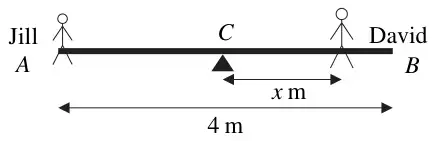
A seesaw in a playground consists of a beam \(AB\) of length 4 m which is supported by a smooth pivot at its centre \(C\). Jill has mass 25 kg and sits on the end \(A\). David has mass 40 kg and sits at a distance \(x\) metres from \(C\), as shown in Figure 1. The beam is initially modelled as a uniform rod. Using this model,
(a) find the value of \(x\) for which the seesaw can rest in equilibrium in a horizontal position. (3)
(b) State what is implied by the modelling assumption that the beam is uniform. (1)
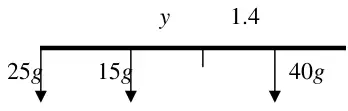
David realises that the beam is not uniform as he finds that he must sit at a distance 1.4 m from \(C\) for the seesaw to rest horizontally in equilibrium. The beam is now modelled as a non-uniform rod of mass 15 kg. Using this model,
(c) find the distance of the centre of mass of the beam from \(C\). (4)
| Scheme | Marks |
|---|---|
| M(\(C\)): \(25g \times 2 = 40g \times x\) | M1 A1 |
| \(x = 1.25\) m | A1 |
| (3) |
| Scheme | Marks |
|---|---|
| Weight/mass acts at mid-point; or weight/mass evenly distributed (o.e.) | B1 |
| (1) |
| Scheme | Marks |
|---|---|
| M(\(C\)): \(40g \times 1.4 = 15g \times y + 25g \times 2\) | M1 A1 |
| Solve: \(y = 0.4\) m | M1 A1 |
| (4) | |
| (8 marks) |