
M1 January 2005 Q4
4.
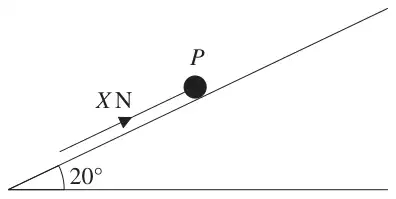
A particle \(P\) of mass 2.5 kg rests in equilibrium on a rough plane under the action of a force of magnitude \(X\) newtons acting up a line of greatest slope of the plane, as shown in Figure 3. The plane is inclined at 20\(^\circ\) to the horizontal. The coefficient of friction between \(P\) and the plane is 0.4. The particle is in limiting equilibrium and is on the point of moving up the plane. Calculate
(a) the normal reaction of the plane on \(P\), (2)
(b) the value of \(X\). (4)
The force of magnitude \(X\) newtons is now removed.
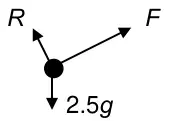
(c) Show that \(P\) remains in equilibrium on the plane. (4)
| Scheme | Marks |
|---|---|
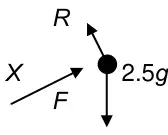
| \(R = 2.5g\cos 20\) | M1 |
| \(\approx 23.0\) or 23 N | A1 |
| (2) |
| Scheme | Marks |
|---|---|
| \(X = 0.4 \times 23.0 + 2.5g\sin 20\) | M1 A2,1,0ft |
| \(\approx 17.6\) or 18 N | A1 |
| (4) |
| Scheme | Marks |
|---|---|
| In equlib. \(F = 2.5g\sin 20 \approx 8.38\) or 8.4 N | B1 |
| \(\mu R = 0.4 \times 2.5g\cos 20 \approx 9.21\) or 9.2 N | B1 |
| \(8.4 \lt 9.2\) (using ‘\(F \lt \mu R\)’ not \(F = \mu R\)) | M1 |
| Since \(F \lt \mu R\) remains in equilibrium (cso) | A1 |
| (4) | |
| (10 marks) |