
M2 January 2012 Q3
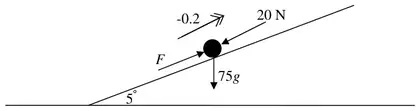
3. A cyclist and her cycle have a combined mass of 75 kg. The cyclist is cycling up a straight road inclined at 5\(^\circ\) to the horizontal. The resistance to the motion of the cyclist from non-gravitational forces is modelled as a constant force of magnitude 20 N. At the instant when the cyclist has a speed of 12 m s\(^{-1}\), she is decelerating at 0.2 m s\(^{-2}\).
(a) Find the rate at which the cyclist is working at this instant. (5)
When the cyclist passes the point \(A\) her speed is 8 m s\(^{-1}\). At \(A\) she stops working but does not apply the brakes. She comes to rest at the point \(B\).
The resistance to motion from non-gravitational forces is again modelled as a constant force of magnitude 20 N.
(b) Use the work-energy principle to find the distance \(AB\). (5)
| Scheme | Marks |
|---|---|
| Driving force = F | M1 |
| Resolving parallel to the plane: \(\ F - 20 - 75g\sin 5 = -75 \times 0.2 = -15\) | A2 – 1ee |
| \(F = 5 + 75g\sin 5^\circ\) | |
| \(P = Fv\quad \therefore\) working at \(\ 12 \times \left(5 + 75g\sin 5^\circ\right) = 828.7\ldots\) | DM1 |
| \(\approx 830\) W | A1 |
| (5) |
| Scheme | Marks |
|---|---|
| Loss in KE = gain in GPE + work done against resistance | M1 |
| \(\dfrac{1}{2} \times 75 \times 64 = 75 \times 9.8 \times \sin 5^\circ d + 20d = d \times 84.059\ldots\) | A2 – 1ee |
| \(d = 28.6\) m | DM1 A1 |
| (5) | |
| (10 marks) |