
M2 January 2009 Q5
5.
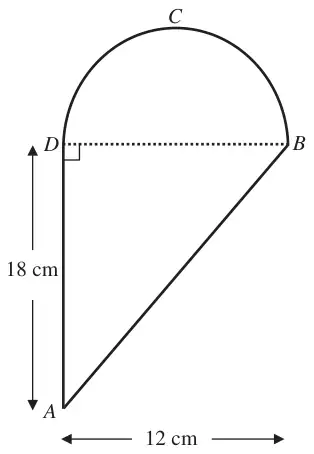
A uniform lamina \(ABCD\) is made by joining a uniform triangular lamina \(ABD\) to a uniform semi-circular lamina \(DBC\), of the same material, along the edge \(BD\), as shown in Figure 2. Triangle \(ABD\) is right-angled at \(D\) and \(AD = 18\) cm. The semi-circle has diameter \(BD\) and \(BD = 12\) cm.
Given that the centre of mass of a uniform semicircular lamina, radius \(r\), is at a distance \(\dfrac{4r}{3\pi}\) from the centre of the bounding diameter,
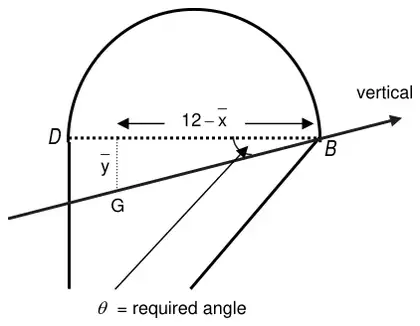
The lamina is freely suspended from \(B\) and hangs in equilibrium.
| Scheme | Marks |
|---|---|
| \(\begin{array}{l|c|c|c} & \text{triangle} & \text{semicircle} & \text{lamina}\\ \text{MR} & 108 & 18\pi & 108 + 18\pi\\ \hline x_i\ (\rightarrow) \text{ from } AD & 4 & 6 & \bar{x}\\ y_i\ (\downarrow) \text{ from } BD & 6 & -\frac{8}{\pi} & \bar{y}\end{array}\) | B1 B1 |
| \(AD(\rightarrow)\): \(108(4) + 18\pi(6) = (108 + 18\pi)\bar{x}\) | M1 |
| \(\bar{x} = \dfrac{432 + 108\pi}{108 + 18\pi} = 4.68731\ldots = 4.69\) (cm) (3 sf) AG | A1 |
| (4) |
Notes
(In the printed table the column headings are small sketches of the triangle, the semicircle and the whole lamina.)
| Scheme | Marks |
|---|---|
| \(y_i\ (\downarrow)\) from \(BD\): \(6\), \(\ -\dfrac{8}{\pi}\), \(\ \bar{y}\) | B1 oe |
| \(BD(\downarrow)\): \(108(6) + 18\pi\left(-\tfrac{8}{\pi}\right) = (108 + 18\pi)\bar{y}\) | M1 A1ft |
| \(\bar{y} = \dfrac{504}{108 + 18\pi} = 3.06292\ldots = 3.06\) (cm) (3 sf) | A1 |
| (4) |
| Scheme | Marks |
|---|---|
 | M1 |
| \(\tan\theta = \dfrac{\bar{y}}{12 - 4.68731..}\) | dM1 |
| \(= \dfrac{3.06292..}{12 - 4.68731..}\) | A1 |
| \(\theta = 22.72641\ldots = 23\) (nearest degree) | A1 |
| (4) | |
| (12 marks) |
Notes
(Corrected from the printed mark scheme: the numerator is printed as 3.06392.., but \(\bar{y} = 3.06292\ldots\) from (b).)