
S1 June 2010 Q6
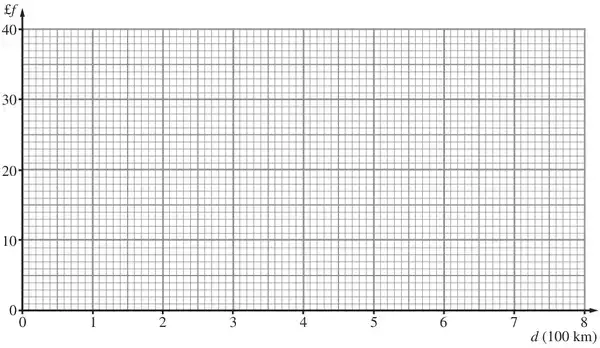
6. A travel agent sells flights to different destinations from Beerow airport. The distance \(d\), measured in 100 km, of the destination from the airport and the fare £\(f\) are recorded for a random sample of 6 destinations.
| Destination | \(A\) | \(B\) | \(C\) | \(D\) | \(E\) | \(F\) |
|---|---|---|---|---|---|---|
| \(d\) | 2.2 | 4.0 | 6.0 | 2.5 | 8.0 | 5.0 |
| \(f\) | 18 | 20 | 25 | 23 | 32 | 28 |
[You may use \(\sum d^2 = 152.09 \quad \sum f^2 = 3686 \quad \sum fd = 723.1\)]
Jane is planning her holiday and wishes to fly from Beerow airport to a destination \(t\) km away. A rival travel agent charges 5p per km.
| Scheme | Marks |
|---|---|
| See overlay | B1 B1 |
| (2) |
Notes
1st B1 for at least 4 points correct (allow \(\pm\) one 2mm square)
2nd B1 for all points correct (allow \(\pm\) one 2 mm square
| Scheme | Marks |
|---|---|
| The points lie reasonably close to a straight line (o.e.) | B1 |
| (1) |
Notes
Ignore extra points and lines
Require reference to points and line for B1.
| Scheme | Marks |
|---|---|
| \(\sum d = 27.7,\quad \sum f = 146\) (both, may be implied) | B1 |
| \(S_{dd} = 152.09 - \dfrac{(27.7)^2}{6} = 24.208\ldots\) awrt 24.2 | M1 A1 |
| \(S_{fd} = 723.1 - \dfrac{27.7 \times 146}{6} = 49.06\ldots\) awrt 49.1 | A1 |
| (4) |
Notes
M1 for a correct method seen for either - a correct expression
1st A1 for \(S_{dd}\) awrt 24.2
2nd A1 for \(S_{fd}\) awrt 49.1
| Scheme | Marks |
|---|---|
| \(b = \dfrac{S_{fd}}{S_{dd}} = 2.026\ldots\) awrt 2.03 | M1 A1 |
| \(a = \dfrac{146}{6} - b \times \dfrac{27.7}{6} = 14.97\ldots\) so \(f = 15.0 + 2.03d\) | M1 A1 |
| (4) |
Notes
1st M1 for a correct expression for \(b\) - can follow through their answers from (c)
2nd M1 for a correct method to find \(a\) - follow through their \(b\) and their means
2nd A1 for \(f\) =.... in terms of \(d\) and all values awrt given expressions. Accept 15 as rounding from correct answer only.
| Scheme | Marks |
|---|---|
| A flight costs £2.03 (or about £2) for every extra 100km or about 2p per km. | B1ft |
| (1) |
Notes
Context of cost and distance required. Follow through their value of \(b\)
| Scheme | Marks |
|---|---|
| \(15.0 + 2.03d \lt 5d\) so \(d \gt \dfrac{15.0}{(5 - 2.03)} = 5.00 \sim 5.05\) | M1 |
| So \(t \gt 500 \sim 505\) | A1 |
| (2) | |
| (14 marks) |
Notes
M1 for an attempt to find the intersection of the 2 lines. Value of \(t\) in range 500 to 505 seen award M1.
Value of \(d\) in range 5 to 5.05 award M1.
Accept \(t\) greater than 500 to 505 inclusive to include graphical solution for M 1A1