
S1 January 2010 Q1
1. A jar contains 2 red, 1 blue and 1 green bead. Two beads are drawn at random from the jar without replacement.
| Scheme | Marks |
|---|---|
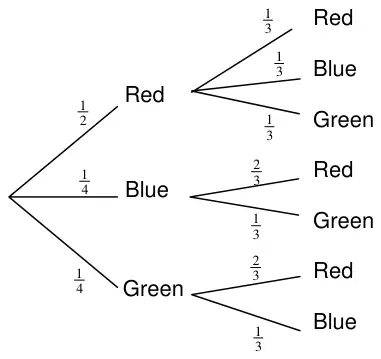 | M1 A1 A1 |
| (3) |
Notes
M1 for shape and labels: 3 branches followed by 3,2,2 with some \(R\), \(B\) and \(G\) seen
Allow 3 branches followed by 3, 3, 3 if 0 probabilities are seen implying that 3, 2, 2 intended
Allow blank branches if the other probabilities imply probability on blanks is zero
Ignore further sets of branches
1st A1 for correct probabilities and correct labels on 1st set of branches.
2nd A1 for correct probabilities and correct labels on 2nd set of branches.
(accept 0.33, 0.67 etc or better here)
Special Case
With Replacement (This oversimplifies so do not apply Mis-Read: max mark 2/5)
(a) B1 for 3 branches followed by 3, 3, 3 with correct labels and probabilities of \(\tfrac{1}{2}, \tfrac{1}{4}, \tfrac{1}{4}\) on each.
| Scheme | Marks |
|---|---|
| P(Blue bead and a green bead) \(= \left(\dfrac{1}{4} \times \dfrac{1}{3}\right) + \left(\dfrac{1}{4} \times \dfrac{1}{3}\right) = \dfrac{1}{6}\) (or any exact equivalent) | M1 A1 |
| (2) | |
| (5 marks) |
Notes
M1 for identifying the 2 cases \(BG\) and \(GB\) and adding 2 products of probabilities.
These cases may be identified by their probabilities e.g. \(\left(\dfrac{1}{4} \times \dfrac{1}{3}\right) + \left(\dfrac{1}{4} \times \dfrac{1}{3}\right)\)
NB \(\tfrac{1}{6}\) (or exact equivalent) with no working scores 2/2
Special Case
With Replacement (This oversimplifies so do not apply Mis-Read: max mark 2/5)
(b) M1 for identifying 2, possibly correct cases and adding 2 products of probabilities but A0 for wrong answer
\(\left[\left(\dfrac{1}{4} \times \dfrac{1}{4}\right) + \left(\dfrac{1}{4} \times \dfrac{1}{4}\right)\right]\) will be sufficient for M1A0 here but \(\dfrac{1}{4} \times \dfrac{1}{2} + \ldots\) would score M0