
M2 January 2006 Q5
5.
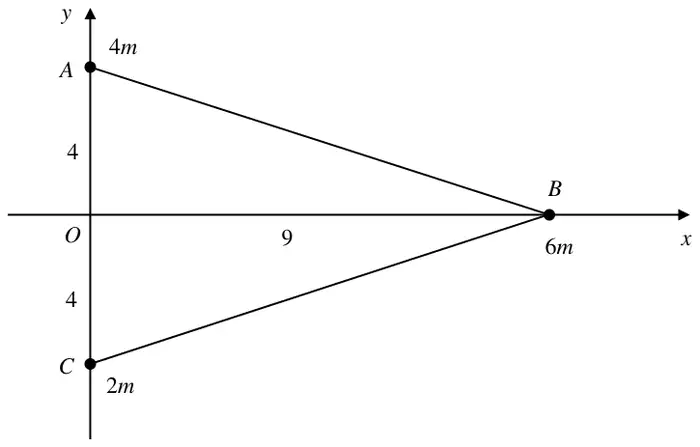
Figure 1 shows a triangular lamina \(ABC\). The coordinates of \(A\), \(B\) and \(C\) are \((0, 4)\), \((9, 0)\) and \((0, -4)\) respectively. Particles of mass \(4m\), \(6m\) and \(2m\) are attached at \(A\), \(B\) and \(C\) respectively.
(a) Calculate the coordinates of the centre of mass of the three particles, without the lamina. (4)
The lamina \(ABC\) is uniform and of mass \(km\). The centre of mass of the combined system consisting of the three particles and the lamina has coordinates \((4, \lambda)\).
(b) Show that \(k = 6\). (3)
(c) Calculate the value of \(\lambda\). (2)
The combined system is freely suspended from \(O\) and hangs at rest.
(d) Calculate, in degrees to one decimal place, the angle between \(AC\) and the vertical. (3)
| Scheme | Marks |
|---|---|
| \(12m\bar{x} = 6m \times 9\) | M1 |
| \(\bar{x} = 4\tfrac{1}{2}\) | A1 |
| \(12m\bar{y} = 16m - 8m\) | M1 |
| \(\bar{y} = \tfrac{2}{3}\) | A1 |
| (4) |
| Scheme | Marks |
|---|---|
| \((12 + k)m \times 4 = 12m \times 4\tfrac{1}{2} + km \times 3\) ft their \(\bar{x}\) | M1 A1ft |
| \(k = 6\) | A1 |
| (3) |
| Scheme | Marks |
|---|---|
| \(18m \times \lambda = 12m \times \tfrac{2}{3},\ \ \Rightarrow\ \ \lambda = \tfrac{4}{9}\) | M1 A1 |
| (2) |
| Scheme | Marks |
|---|---|
| \(\tan\theta = \dfrac{4}{\frac{4}{9}},\ \ \Rightarrow\ \ \theta \approx 83.7^\circ\) ft their \(\lambda\), cao | M1 A1ft A1 |
| (3) | |
| (12 marks) |
Notes
(The question paper prints this part as a second (c).)