
C4 June 2017 Q5
5.
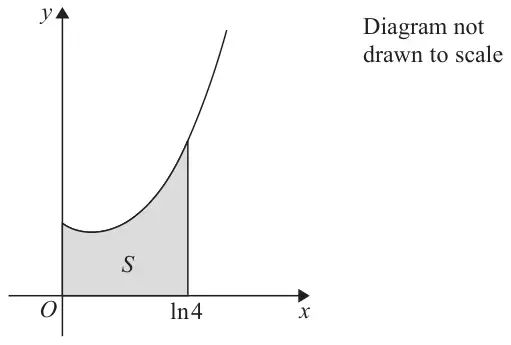
The finite region \(S\), shown shaded in Figure 2, is bounded by the \(y\)-axis, the \(x\)-axis, the line with equation \(x = \ln 4\) and the curve with equation \[y = \mathrm{e}^x + 2\mathrm{e}^{-x}, \qquad x \geqslant 0\]
The region \(S\) is rotated through \(2\pi\) radians about the \(x\)-axis.
Use integration to find the exact value of the volume of the solid generated.
Give your answer in its simplest form.
[Solutions based entirely on graphical or numerical methods are not acceptable.] (7)
| Scheme | Marks |
|---|---|
| \(y = \mathrm{e}^x + 2\mathrm{e}^{-x},\ x \geqslant 0\) | |
| Way 1 | |
| \(\{V =\}\ \pi\displaystyle\int_0^{\ln 4} \left(\mathrm{e}^x + 2\mathrm{e}^{-x}\right)^2\mathrm{d}x\) For \(\pi\displaystyle\int \left(\mathrm{e}^x + 2\mathrm{e}^{-x}\right)^2\). Ignore limits and \(\mathrm{d}x\). Can be implied. | B1 |
| \(= \{\pi\}\displaystyle\int_0^{\ln 4} \left(\mathrm{e}^{2x} + 4\mathrm{e}^{-2x} + 4\right)\mathrm{d}x\) Expands \(\left(\mathrm{e}^x + 2\mathrm{e}^{-x}\right)^2 \to \pm\alpha\mathrm{e}^{2x} \pm \beta\mathrm{e}^{-2x} \pm \delta\) where \(\alpha, \beta, \delta \neq 0\). Ignore \(\pi\), integral sign, limits and \(\mathrm{d}x\). This can be implied by later work. | M1 |
| \(= \{\pi\}\left[\dfrac{1}{2}\mathrm{e}^{2x} - 2\mathrm{e}^{-2x} + 4x\right]_0^{\ln 4}\) Integrates at least one of either \(\pm\alpha\mathrm{e}^{2x}\) to give \(\pm\dfrac{\alpha}{2}\mathrm{e}^{2x}\) or \(\pm\beta\mathrm{e}^{-2x}\) to give \(\pm\dfrac{\beta}{2}\mathrm{e}^{-2x}\) \(\alpha, \beta \neq 0\) dependent on the 2nd M mark \(\mathrm{e}^{2x} + 4\mathrm{e}^{-2x} \to \dfrac{1}{2}\mathrm{e}^{2x} - 2\mathrm{e}^{-2x}\), which can be simplified or un-simplified \(4 \to 4x\) or \(4\mathrm{e}^0x\) | M1 A1 B1 cao |
| \(= \{\pi\}\left(\left(\dfrac{1}{2}\mathrm{e}^{2(\ln 4)} - 2\mathrm{e}^{-2(\ln 4)} + 4(\ln 4)\right) - \left(\dfrac{1}{2}\mathrm{e}^0 - 2\mathrm{e}^0 + 4(0)\right)\right)\) dependent on the previous method mark. Some evidence of applying limits of \(\ln 4\) o.e. and 0 to a changed function in \(x\) and subtracts the correct way round. Note: A proper consideration of the limit of 0 is required. | dM1 |
| \(= \{\pi\}\left(\left(8 - \dfrac{1}{8} + 4\ln 4\right) - \left(\dfrac{1}{2} - 2\right)\right)\) | |
| \(= \dfrac{75}{8}\pi + 4\pi\ln 4\) or \(\dfrac{75}{8}\pi + 8\pi\ln 2\) or \(\pi\left(\dfrac{75}{8} + 4\ln 4\right)\) or \(\pi\left(\dfrac{75}{8} + 8\ln 2\right)\) or \(\dfrac{75}{8}\pi + \ln 2^{8\pi}\) or \(\dfrac{75}{8}\pi + \pi\ln 256\) or \(\ln\left(2^{8\pi}\mathrm{e}^{\frac{75}{8}\pi}\right)\) or \(\dfrac{1}{8}\pi(75 + 32\ln 4)\), etc | A1 isw |
| (7) | |
| (7 marks) |
Notes
Note: \(\pi\) is only required for the 1st B1 mark and the final A1 mark.
Note: Give 1st B0 for writing \(\pi\displaystyle\int y^2\,\mathrm{d}x\) followed by \(2\pi\displaystyle\int \left(\mathrm{e}^x + 2\mathrm{e}^{-x}\right)^2\mathrm{d}x\)
Note: Give 1st M1 for \(\left(\mathrm{e}^x + 2\mathrm{e}^{-x}\right)^2 \to \mathrm{e}^{2x} + 4\mathrm{e}^{-2x} + 2\mathrm{e}^0 + 2\mathrm{e}^0\) because \(\delta = 2\mathrm{e}^0 + 2\mathrm{e}^0\)
Note: A decimal answer of 46.8731… or \(\pi(14.9201\ldots)\) (without a correct exact answer) is A0
Note: \(\pi\left[\dfrac{1}{2}\mathrm{e}^{2x} - 2\mathrm{e}^{-2x} + 4x\right]_0^{\ln 4}\) followed by awrt 46.9 (without a correct exact answer) is final dM1A0
Note: Allow exact equivalents which should be in the form \(a\pi + b\pi\ln c\) or \(\pi(a + b\ln c)\), where \(a = \dfrac{75}{8}\) or \(9\dfrac{3}{8}\) or 9.375. Do not allow \(a = \dfrac{150}{16}\) or \(9\dfrac{6}{16}\)
Note: Give B1M0M1A1B0M1A0 for the common response
\(\pi\displaystyle\int_0^{\ln 4} \left(\mathrm{e}^x + 2\mathrm{e}^{-x}\right)^2\mathrm{d}x \to \pi\displaystyle\int_0^{\ln 4} \left(\mathrm{e}^{2x} + 4\mathrm{e}^{-2x}\right)\mathrm{d}x = \pi\left[\dfrac{1}{2}\mathrm{e}^{2x} - 2\mathrm{e}^{-2x}\right]_0^{\ln 4} = \dfrac{75}{8}\pi\)
Way 2
| Scheme | Marks |
|---|---|
| \(\{V =\}\ \pi\displaystyle\int_0^{\ln 4} \left(\mathrm{e}^x + 2\mathrm{e}^{-x}\right)^2\mathrm{d}x\) For \(\pi\displaystyle\int \left(\mathrm{e}^x + 2\mathrm{e}^{-x}\right)^2\). Ignore limits and \(\mathrm{d}x\). Can be implied. | B1 |
| \(u = \mathrm{e}^x \Rightarrow \dfrac{\mathrm{d}u}{\mathrm{d}x} = \mathrm{e}^x = u\) and \(x = \ln 4 \Rightarrow u = 4,\ x = 0 \Rightarrow u = \mathrm{e}^0 = 1\) | |
| \(V = \{\pi\}\displaystyle\int_1^4 \left(u + \dfrac{2}{u}\right)^2\dfrac{1}{u}\,\mathrm{d}u = \{\pi\}\displaystyle\int_1^4 \left(u^2 + \dfrac{4}{u^2} + 4\right)\dfrac{1}{u}\,\mathrm{d}u\) | |
| \(= \{\pi\}\displaystyle\int_1^4 \left(u + \dfrac{4}{u^3} + \dfrac{4}{u}\right)\mathrm{d}u\) \(\left(\mathrm{e}^x + 2\mathrm{e}^{-x}\right)^2 \to \pm\alpha u \pm \beta u^{-3} \pm \delta u^{-1}\) where \(u = \mathrm{e}^x\), \(\alpha, \beta, \delta \neq 0\). Ignore \(\pi\), integral sign, limits and \(\mathrm{d}u\). This can be implied by later work. | M1 |
| \(= \{\pi\}\left[\dfrac{1}{2}u^2 - \dfrac{2}{u^2} + 4\ln u\right]_1^4\) Integrates at least one of either \(\pm\alpha u\) to give \(\pm\dfrac{\alpha}{2}u^2\) or \(\pm\beta u^{-3}\) to give \(\pm\dfrac{\beta}{2}u^{-2}\) \(\alpha, \beta \neq 0\), where \(u = \mathrm{e}^x\) dependent on the 2nd M mark \(u + 4u^{-3} \to \dfrac{1}{2}u^2 - 2u^{-2}\), simplified or un-simplified, where \(u = \mathrm{e}^x\) \(4u^{-1} \to 4\ln u\), where \(u = \mathrm{e}^x\) | M1 A1 B1 cao |
| \(= \{\pi\}\left(\left(\dfrac{1}{2}(4)^2 - \dfrac{2}{(4)^2} + 4\ln 4\right) - \left(\dfrac{1}{2}(1)^2 - \dfrac{2}{(1)^2} + 4\ln 1\right)\right)\) dependent on the previous method mark. Some evidence of applying limits of 4 and 1 to a changed function in \(u\) [or \(\ln 4\) o.e. and 0 to an integrated function in \(x\)] and subtracts the correct way round. | dM1 |
| \(= \{\pi\}\left(\left(8 - \dfrac{1}{8} + 4\ln 4\right) - \left(\dfrac{1}{2} - 2\right)\right)\) | |
| \(= \dfrac{75}{8}\pi + 4\pi\ln 4\) or \(\dfrac{75}{8}\pi + 8\pi\ln 2\) or \(\pi\left(\dfrac{75}{8} + 4\ln 4\right)\) or \(\pi\left(\dfrac{75}{8} + 8\ln 2\right)\) or \(\dfrac{75}{8}\pi + \ln 2^{8\pi}\) or \(\dfrac{75}{8}\pi + \pi\ln 256\) or \(\ln\left(2^{8\pi}\mathrm{e}^{\frac{75}{8}\pi}\right)\) or \(\dfrac{1}{8}\pi(75 + 32\ln 4)\), etc | A1 isw |
| (7) |