
C4 June 2015 Q8
8.
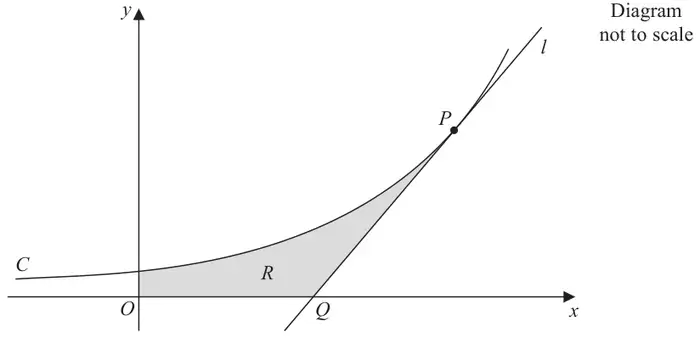
Figure 3 shows a sketch of part of the curve \(C\) with equation \[y = 3^x\]
The point \(P\) lies on \(C\) and has coordinates \((2, 9)\).
The line \(l\) is a tangent to \(C\) at \(P\). The line \(l\) cuts the \(x\)-axis at the point \(Q\).
The finite region \(R\), shown shaded in Figure 3, is bounded by the curve \(C\), the \(x\)-axis, the \(y\)-axis and the line \(l\). This region \(R\) is rotated through \(360^\circ\) about the \(x\)-axis.
Give your answer in the form \(\dfrac{p}{q}\) where \(p\) and \(q\) are exact constants.
[You may assume the formula \(V = \dfrac{1}{3}\pi r^2 h\) for the volume of a cone.] (6)
| Scheme | Marks |
|---|---|
| \(\left\{y = 3^x \Rightarrow\right\}\ \dfrac{\mathrm{d}y}{\mathrm{d}x} = 3^x\ln 3\) \(\dfrac{\mathrm{d}y}{\mathrm{d}x} = 3^x\ln 3\) or \(\ln 3\left(\mathrm{e}^{x\ln 3}\right)\) or \(y\ln 3\) | B1 |
| Either T: \(y - 9 = 3^2\ln 3(x - 2)\) or T: \(y = (3^2\ln 3)x + 9 - 18\ln 3\), where \(9 = (3^2\ln 3)(2) + c\) See notes | M1 |
| \(\{\text{Cuts } x\text{-axis} \Rightarrow y = 0 \Rightarrow\}\) | |
| \(-9 = 9\ln 3(x - 2)\) or \(0 = (3^2\ln 3)x + 9 - 18\ln 3\), Sets \(y = 0\) in their tangent equation and progresses to \(x = \ldots\) | M1 |
| So, \(x = 2 - \dfrac{1}{\ln 3}\) \(2 - \dfrac{1}{\ln 3}\) or \(\dfrac{2\ln 3 - 1}{\ln 3}\) o.e. | A1 cso |
| (4) |
Notes
B1: \(\dfrac{\mathrm{d}y}{\mathrm{d}x} = 3^x\ln 3\) or \(\ln 3\left(\mathrm{e}^{x\ln 3}\right)\) or \(y\ln 3\). Can be implied by later working.
M1: Substitutes either \(x = 2\) or \(y = 9\) into their \(\dfrac{\mathrm{d}y}{\mathrm{d}x}\) which is a function of \(x\) or \(y\) to find \(m_T\) and
- either applies \(y - 9 = (\text{their } m_T)(x - 2)\), where \(m_T\) is a numerical value.
- or applies \(y = (\text{their } m_T)x + \text{their } c\), where \(m_T\) is a numerical value and \(c\) is found by solving \(9 = (\text{their } m_T)(2) + c\)
Note: The first M1 mark can be implied from later working.
M1: Sets \(y = 0\) in their tangent equation, where \(m_T\) is a numerical value, (seen or implied) and progresses to \(x = \ldots\)
A1: An exact value of \(2 - \dfrac{1}{\ln 3}\) or \(\dfrac{2\ln 3 - 1}{\ln 3}\) or \(\dfrac{\ln 9 - 1}{\ln 3}\) by a correct solution only.
Note: Allow A1 for \(2 - \dfrac{\lambda}{\lambda\ln 3}\) or \(\dfrac{\lambda(2\ln 3 - 1)}{\lambda\ln 3}\) or \(\dfrac{\lambda(\ln 9 - 1)}{\lambda\ln 3}\) or \(2 - \dfrac{\lambda}{\lambda\ln 3}\), where \(\lambda\) is an integer, and ignore subsequent working.
Note: Using a changed gradient (i.e. applying \(\dfrac{-1}{\text{their } \frac{\mathrm{d}y}{\mathrm{d}x}}\) or \(\dfrac{1}{\text{their } \frac{\mathrm{d}y}{\mathrm{d}x}}\)) is M0 M0 in part (a).
Note: Candidates who invent a value for \(m_T\) (which bears no resemblance to their gradient function) cannot gain the 1st M1 and 2nd M1 mark in part (a).
Note: A decimal answer of 1.089760773… (without a correct exact answer) is A0.
| Scheme | Marks |
|---|---|
| \(V = \pi\displaystyle\int \left(3^x\right)^2\{\mathrm{d}x\}\) or \(\pi\displaystyle\int 3^{2x}\{\mathrm{d}x\}\) or \(\pi\displaystyle\int 9^x\{\mathrm{d}x\}\) \(V = \pi\displaystyle\int \left(3^x\right)^2\) with or without \(\mathrm{d}x\), which can be implied | B1 o.e. |
| \(= \{\pi\}\left(\dfrac{3^{2x}}{2\ln 3}\right)\) or \(= \{\pi\}\left(\dfrac{9^x}{\ln 9}\right)\) Eg: either \(3^{2x} \to \dfrac{3^{2x}}{\pm\alpha(\ln 3)}\) or \(\pm\alpha(\ln 3)3^{2x}\) or \(9^x \to \dfrac{9^x}{\pm\alpha(\ln 9)}\) or \(\pm\alpha(\ln 9)9^x\), \(\underline{\underline{\alpha \in \mathbb{R}}}\) \(3^{2x} \to \dfrac{3^{2x}}{2\ln 3}\) or \(9^x \to \dfrac{9^x}{\ln 9}\) or \(\mathrm{e}^{2x\ln 3} \to \dfrac{1}{2\ln 3}\left(\mathrm{e}^{2x\ln 3}\right)\) | M1 A1 o.e. |
| \(\left\{V = \pi\displaystyle\int_0^2 3^{2x}\,\mathrm{d}x = \{\pi\}\left[\dfrac{3^{2x}}{2\ln 3}\right]_0^2\right\} = \{\pi\}\left(\dfrac{3^4}{2\ln 3} - \dfrac{1}{2\ln 3}\right)\ \left\{= \dfrac{40\pi}{\ln 3}\right\}\) Dependent on the previous method mark. Substitutes \(x = 2\) and \(x = 0\) and subtracts the correct way round. | dM1 |
| \(V_{\text{cone}} = \dfrac{1}{3}\pi(9)^2\left(\dfrac{1}{\ln 3}\right)\ \left\{= \dfrac{27\pi}{\ln 3}\right\}\) \(V_{\text{cone}} = \dfrac{1}{3}\pi(9)^2\left(2 - \text{their } (a)\right)\). See notes. | B1ft |
| \(\left\{\text{Vol}(S) = \dfrac{40\pi}{\ln 3} - \dfrac{27\pi}{\ln 3}\right\} = \underline{\dfrac{13\pi}{\ln 3}}\) \(\dfrac{13\pi}{\ln 3}\) or \(\dfrac{26\pi}{\ln 9}\) or \(\dfrac{26\pi}{2\ln 3}\) etc., isw \(\{\text{Eg: } p = 13\pi,\ q = \ln 3\}\) | A1 o.e. |
| (6) | |
| (10 marks) |
Notes
B1: A correct expression for the volume with or without \(\mathrm{d}x\)
Note: Eg: Allow B1 for \(\pi\displaystyle\int \left(3^x\right)^2\{\mathrm{d}x\}\) or \(\pi\displaystyle\int 3^{2x}\{\mathrm{d}x\}\) or \(\pi\displaystyle\int 9^x\{\mathrm{d}x\}\) or \(\pi\displaystyle\int \left(\mathrm{e}^{x\ln 3}\right)^2\{\mathrm{d}x\}\) or \(\pi\displaystyle\int \left(\mathrm{e}^{2x\ln 3}\right)\{\mathrm{d}x\}\) or \(\pi\displaystyle\int \mathrm{e}^{x\ln 9}\{\mathrm{d}x\}\) with or without \(\mathrm{d}x\)
M1: Either \(3^{2x} \to \dfrac{3^{2x}}{\pm\alpha(\ln 3)}\) or \(\pm\alpha(\ln 3)3^{2x}\) or \(9^x \to \dfrac{9^x}{\pm\alpha(\ln 9)}\) or \(\pm\alpha(\ln 9)9^x\)
\(\mathrm{e}^{2x\ln 3} \to \dfrac{\mathrm{e}^{2x\ln 3}}{\pm\alpha(\ln 3)}\) or \(\pm\alpha(\ln 3)\mathrm{e}^{2x\ln 3}\) or \(\mathrm{e}^{x\ln 9} \to \dfrac{\mathrm{e}^{x\ln 9}}{\pm\alpha(\ln 9)}\) or \(\pm\alpha(\ln 9)\mathrm{e}^{x\ln 9}\), etc where \(\alpha \in \mathbb{R}\)
Note: \(3^{2x} \to \dfrac{3^{2x+1}}{\pm\alpha(\ln 3)}\) or \(9^x \to \dfrac{9^{x+1}}{\pm\alpha(\ln 3)}\) are allowed for M1
Note: \(3^{2x} \to \dfrac{3^{2x+1}}{2x + 1}\) or \(9^x \to \dfrac{9^{x+1}}{x + 1}\) are both M0
Note: M1 can be given for \(9^{2x} \to \dfrac{9^{2x}}{\pm\alpha(\ln 9)}\) or \(\pm\alpha(\ln 9)9^{2x}\)
A1: Correct integration of \(3^{2x}\). Eg: \(3^{2x} \to \dfrac{3^{2x}}{2\ln 3}\) or \(\dfrac{3^{2x}}{\ln 9}\) or \(9^x \to \dfrac{9^x}{\ln 9}\) or \(\mathrm{e}^{2x\ln 3} \to \dfrac{1}{2\ln 3}\left(\mathrm{e}^{2x\ln 3}\right)\)
dM1: dependent on the previous method mark being awarded.
Attempts to apply \(x = 2\) and \(x = 0\) to integrated expression and subtracts the correct way round.
Note: Evidence of a proper consideration of the limit of 0 is needed for M1. So subtracting 0 is M0.
B1ft: \(V_{\text{cone}} = \dfrac{1}{3}\pi(9)^2\left(2 - \text{their answer to part } (a)\right)\).
Sight of \(\dfrac{27\pi}{\ln 3}\) implies the B1 mark.
Note: Alternatively they can apply the volume formula to the line segment. They need to achieve the result highlighted by **** on either page 29 or page 30 in order to obtain the B1ft mark.
A1: \(\dfrac{13\pi}{\ln 3}\) or \(\dfrac{26\pi}{\ln 9}\) or \(\dfrac{26\pi}{2\ln 3}\), etc., where their answer is in the form \(\dfrac{p}{q}\)
Note: The \(\pi\) in the volume formula is only needed for the 1st B1 mark and the final A1 mark.
Note: A decimal answer of 37.17481128… (without a correct exact answer) is A0.
Note: A candidate who applies \(\displaystyle\int 3^x\,\mathrm{d}x\) will either get B0 M0 A0 M0 B0 A0 or B0 M0 A0 M0 B1 A0
Note: \(\pi\displaystyle\int 3^{x^2}\,\mathrm{d}x\) unless recovered is B0.
Note: Be careful! A correct answer may follow from incorrect working
\(V = \pi\displaystyle\int_0^2 3^{x^2}\,\mathrm{d}x - \dfrac{1}{3}\pi(9)^2\left(\dfrac{1}{\ln 3}\right) = \pi\left[\dfrac{3^{x^2}}{2\ln 3}\right]_0^2 - \dfrac{27\pi}{\ln 3} = \dfrac{\pi 3^4}{2\ln 3} - \dfrac{\pi}{2\ln 3} - \dfrac{27\pi}{\ln 3} = \dfrac{13\pi}{\ln 3}\)
would score B0 M0 A0 dM0 M1 A0.
Alternative Method 1: Use of a substitution
| Scheme | Marks |
|---|---|
| \(V = \pi\displaystyle\int \left(3^x\right)^2\{\mathrm{d}x\}\) | B1 o.e. |
| \(\left\{u = 3^x \Rightarrow \dfrac{\mathrm{d}u}{\mathrm{d}x} = 3^x\ln 3 = u\ln 3\right\}\ V = \{\pi\}\displaystyle\int \dfrac{u^2}{u\ln 3}\{\mathrm{d}u\} = \{\pi\}\displaystyle\int \dfrac{u}{\ln 3}\{\mathrm{d}u\}\) | |
| \(= \{\pi\}\left(\dfrac{u^2}{2\ln 3}\right)\) \(\left(3^x\right)^2 \to \dfrac{u^2}{\pm\alpha(\ln 3)}\) or \(\pm\alpha(\ln 3)u^2\), where \(u = 3^x\) \(\left(3^x\right)^2 \to \dfrac{u^2}{2(\ln 3)}\), where \(u = 3^x\) | M1 A1 |
| \(\left\{V = \pi\displaystyle\int_0^2 \left(3^x\right)^2\,\mathrm{d}x = \{\pi\}\left[\dfrac{u^2}{2\ln 3}\right]_1^9\right\} = \{\pi\}\left(\dfrac{9^2}{2\ln 3} - \dfrac{1}{2\ln 3}\right)\ \left\{= \dfrac{40\pi}{\ln 3}\right\}\) Substitutes limits of 9 and 1 in \(u\) (or 2 and 0 in \(x\)) and subtracts the correct way round. | dM1 |
| then apply the main scheme. |
2nd B1ft mark for finding the Volume of a Cone
| \(V_{\text{cone}} = \pi\displaystyle\int_{2 - \frac{1}{\ln 3}}^{2} \left(9x\ln 3 - 18\ln 3 + 9\right)^2\,\mathrm{d}x\) | |
| \(= \pi\left[\dfrac{\left(9x\ln 3 - 18\ln 3 + 9\right)^3}{27\ln 3}\right]_{2 - \frac{1}{\ln 3} \text{ or their part (a) answer}}^{2}\) **** Award B1ft here where their lower limit is \(2 - \dfrac{1}{\ln 3}\) or their part (a) answer. | |
| \(= \pi\left(\left(\dfrac{\left(18\ln 3 - 18\ln 3 + 9\right)^3}{27\ln 3}\right) - \left(\dfrac{\left(9\left(2 - \frac{1}{\ln 3}\right)\ln 3 - 18\ln 3 + 9\right)^3}{27\ln 3}\right)\right)\) | |
| \(= \pi\left(\left(\dfrac{729}{27\ln 3}\right) - \left(\dfrac{\left(18\ln 3 - 9 - 18\ln 3 + 9\right)^3}{27\ln 3}\right)\right)\) | |
| \(= \dfrac{27\pi}{\ln 3}\) |
2nd B1ft mark for finding the Volume of a Cone — Alternative method 2:
| \(V_{\text{cone}} = \pi\displaystyle\int_{2 - \frac{1}{\ln 3}}^{2} \left(9x\ln 3 - 18\ln 3 + 9\right)^2\,\mathrm{d}x\) | |
| \(= \pi\displaystyle\int_{2 - \frac{1}{\ln 3}}^{2} \left(81x^2(\ln 3)^2 - 324x(\ln 3)^2 + 162x\ln 3 - 324\ln 3 + 324(\ln 3)^2 + 81\right)\mathrm{d}x\) | |
| \(= \pi\left[27x^3(\ln 3)^2 - 162x^2(\ln 3)^2 + 81x^2\ln 3 - 324x\ln 3 + 324x(\ln 3)^2 + 81x\right]_{2 - \frac{1}{\ln 3}}^{2}\) **** Award B1ft here where their lower limit is \(2 - \dfrac{1}{\ln 3}\) or their part (a) answer. | |
| \(= \pi\left(\begin{aligned}&\left(216(\ln 3)^2 - 648(\ln 3)^2 + 324\ln 3 - 648\ln 3 + 648(\ln 3)^2 + 162\right)\\ &- \left(\begin{aligned}&27\left(2 - \tfrac{1}{\ln 3}\right)^3(\ln 3)^2 - 162\left(2 - \tfrac{1}{\ln 3}\right)^2(\ln 3)^2 + 81\left(2 - \tfrac{1}{\ln 3}\right)^2\ln 3\\ &- 324\left(2 - \tfrac{1}{\ln 3}\right)\ln 3 + 324\left(2 - \tfrac{1}{\ln 3}\right)(\ln 3)^2 + 81\left(2 - \tfrac{1}{\ln 3}\right)\end{aligned}\right)\end{aligned}\right)\) | |
| \(= \pi\left(\left(216(\ln 3)^2 - 324\ln 3 + 162\right) - \left(\begin{aligned}&27\left(8 - \tfrac{12}{\ln 3} + \tfrac{6}{(\ln 3)^2} - \tfrac{1}{(\ln 3)^3}\right)(\ln 3)^2 - 162\left(4 - \tfrac{4}{\ln 3} + \tfrac{1}{(\ln 3)^2}\right)(\ln 3)^2\\ &+ 81\left(4 - \tfrac{4}{\ln 3} + \tfrac{1}{(\ln 3)^2}\right)\ln 3 - 324\left(2 - \tfrac{1}{\ln 3}\right)\ln 3\\ &+ 324\left(2 - \tfrac{1}{\ln 3}\right)(\ln 3)^2 + 81\left(2 - \tfrac{1}{\ln 3}\right)\end{aligned}\right)\right)\) | |
| \(= \pi\left(\left(216(\ln 3)^2 - 324\ln 3 + 162\right) - \left(\begin{aligned}&216(\ln 3)^2 - 324\ln 3 + 162 - \tfrac{27}{\ln 3} - 648(\ln 3)^2 + 648\ln 3 - 162\\ &+ 324\ln 3 - 324 + \tfrac{81}{\ln 3} - 648\ln 3 + 324\\ &+ 648(\ln 3)^2 - 324\ln 3 + 162 - \tfrac{81}{\ln 3}\end{aligned}\right)\right)\) | |
| \(= \pi\left(\left(216(\ln 3)^2 - 324\ln 3 + 162\right) - \left(216(\ln 3)^2 - 324\ln 3 + 162 - \dfrac{27}{\ln 3}\right)\right)\) | |
| \(= \dfrac{27\pi}{\ln 3}\) |