
S2 January 2009 Q4
4. The length of a telephone call made to a company is denoted by the continuous random variable \(T\). It is modelled by the probability density function
\[\mathrm{f}(t) = \begin{cases} kt & 0 \leqslant t \leqslant 10 \\ 0 & \text{otherwise} \end{cases}\](a) Show that the value of \(k\) is \(\dfrac{1}{50}\). (3)
(b) Find \(\mathrm{P}(T \gt 6)\). (2)
(c) Calculate an exact value for \(\mathrm{E}(T)\) and for \(\mathrm{Var}(T)\). (5)
(d) Write down the mode of the distribution of \(T\). (1)
It is suggested that the probability density function, \(\mathrm{f}(t)\), is not a good model for \(T\).
(e) Sketch the graph of a more suitable probability density function for \(T\). (1)
| Scheme | Marks |
|---|---|
| \(\displaystyle\int_0^{10} kt\,\mathrm{d}t = 1\) or Area of triangle = 1 | M1 |
| \(\left[\dfrac{kt^2}{2}\right]_0^{10} = 1\) or \(10 \times 0.5 \times 10k = 1\) or linear equation in \(k\) | M1 |
| \(50k = 1\) \(k = \tfrac{1}{50}\) cso | A1 |
| (3) |
| Scheme | Marks |
|---|---|
| \(\displaystyle\int_6^{10} kt\,dt = \left[\dfrac{kt^2}{2}\right]_6^{10}\) | M1 |
| \(= \tfrac{16}{25}\) | A1 |
| (2) |
| Scheme | Marks |
|---|---|
| \(\mathrm{E}(T) = \displaystyle\int_0^{10} kt^2\,dt = \left[\dfrac{kt^3}{3}\right]_0^{10}\) | M1 |
| \(= 6\tfrac{2}{3}\) | A1 |
| \(\mathrm{Var}(T) = \displaystyle\int_0^{10} kt^3\,dt - \left(6\dfrac{2}{3}\right)^2 = \left[\dfrac{kt^4}{4}\right]_0^{10}; -\left(6\dfrac{2}{3}\right)^2\) | M1;M1dep |
| \(= 50 - \left(6\tfrac{2}{3}\right)^2\) \(= 5\tfrac{5}{9}\) | A1 |
| (5) |
| Scheme | Marks |
|---|---|
| 10 | B1 |
| (1) |
| Scheme | Marks |
|---|---|
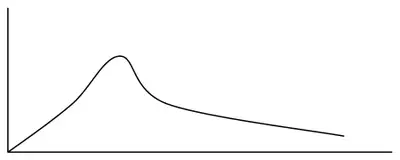 | B1 |
| (1) | |
| (12 marks) |