
S2 January 2012 Q6
6. A random variable \(X\) has probability density function given by
\[\mathrm{f}(x) = \begin{cases} \dfrac{1}{2} & 0 \leqslant x \lt 1 \\ x - \dfrac{1}{2} & 1 \leqslant x \leqslant k \\ 0 & \text{otherwise} \end{cases}\]where \(k\) is a positive constant.
| Scheme | Marks |
|---|---|
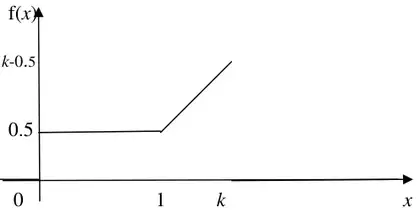 | B1 B1 |
| (2) |
Notes
shape B1; labels B1
1st B1 Correct shape with straight lines. Must all be above the \(x\)-axis
2nd B1 A fully correct graph with the labels 1, \(k\), 0.5, \(k\) - 0.5 seen in the correct places.
Allow the use of \(\dfrac{1}{2}(1 + \sqrt{5})\)/awrt 1.62 instead of \(k\).
| Scheme | Marks |
|---|---|
| \(\displaystyle\int_1^k \left(x - \frac{1}{2}\right)\mathrm{d}x = \frac{1}{2}\) | M1 |
| \(\left[\dfrac{1}{2}x^2 - \dfrac{1}{2}x\right]_1^k = \dfrac{1}{2}\) \(k^2 - k - 1 = 0\) o.e. | A1 |
| \(k = \dfrac{1}{2}\left(1 + \sqrt{5}\right)\) | M1A1 cso |
| (4) |
Notes
1st M1 \(\displaystyle\int_1^k x - \frac{1}{2}\,\mathrm{d}x = 0.5\)
or \(\displaystyle\int_1^k x - \frac{1}{2}\,\mathrm{d}x + 0.5 = 1\) ignore limits
or \(\displaystyle\int_1^k x - \frac{1}{2}\,\mathrm{d}x + \int_1^k \frac{1}{2}\,\mathrm{d}x = 1\)
or \(\dfrac{1}{2}(k - 0.5 + 0.5)(k - 1) = 0.5\) or any correct method of finding the area
1st A1 for a quadratic equation in the form \(a(k^2 - k - 1) = 0\) or \(ak^2 - ak = a\). where \(a\) is a constant.
2nd M1 correct method for solving a quadratic of the form \(ak^2 - bk + c = 0\) where \(a, b, c \neq 0\). There must be at least one correct step before the final answer. Allow substituting in \(k\) into a quadratic of the form \(ak^2 - bk + c = 0\).
2nd A1 cso for \(k = \dfrac{1}{2}\left(1 + \sqrt{5}\right)\)
| Scheme | Marks |
|---|---|
| \(F(x) = \begin{cases} 0, & x \lt 0 \\ \dfrac{1}{2}x, & 0 \leqslant x \lt 1 \\ \dfrac{1}{2}x^2 - \dfrac{1}{2}x + \dfrac{1}{2}, & 1 \leqslant x \leqslant k \\ 1, & x \gt k \end{cases}\) | B1 M1A1A1B1 B1 1st and last |
| Note: Working for the M1A1A1 \(\displaystyle\int_1^k x - \frac{1}{2}\,\mathrm{d}x + \mathrm{C} = \frac{1}{2}x^2 - \frac{1}{2}x\ ; + \frac{1}{2}\) | (M1A1;A1) |
| (6) |
Notes
1st B1 for second line. Do not penalise the use of < instead of \(\leqslant\) and vice versa
M1 for use of \(\displaystyle\int_1^k x - \frac{1}{2}\,\mathrm{d}x + \mathrm{C}\) ignore limits. For use they must have \(x \to x^2\)
1st A1 correct integration \(\dfrac{1}{2}x^2 - \dfrac{1}{2}x\)
2nd A1 \(\mathrm{C} = \dfrac{1}{2}\)
NB M1A1A1 may be implied by correct 3rd line in F(\(x\))
2nd B1 for 3rd line. Statement of the form \(\dfrac{1}{2}x^2 - \dfrac{1}{2}x \pm C\). Do not penalise the use of < instead of \(\leqslant\) and vice versa. Allow \(k\) or value of \(k\). \(C\) may equal 0.
3rd B1 for first and last line. Do not penalise the use of \(\leqslant\) instead of < and \(\geqslant\) instead of > . Allow \(k\) or value of \(k\)
| Scheme | Marks |
|---|---|
| \(\mathrm{P}(0.5 \lt X \lt 1.5) = \mathrm{F}(1.5) - \mathrm{F}(0.5)\) \(= 0.875 - 0.25\) | M1 |
| \(= 0.625\) | A1 |
| (2) |
Notes
M1 Using F(1.5) - F(0.5) . 1.5 must be put into the third line of the c.d.f. and 0.5 must be put into the second line of the c.d.f..
or \(\displaystyle\int_{0.5}^{1} \frac{1}{2}x\,\mathrm{d}x + \int_1^{1.5} x - \frac{1}{2}\,\mathrm{d}x\) need to attempt integration, at least one \(x^n \to x^{n+1}\)
or seeing 0.25 + 0.375 or any correct method of finding the area..
(NB if they have not used + C or C = 0 they will get 0.125. This will get M1A0). An answer of 0.125 from an incorrect method gains M0 A0.
| Scheme | Marks |
|---|---|
| Median is \(x = 1\) | B1 |
| Mode is \(x = k\) or \(\dfrac{1}{2}(1 + \sqrt{5})\) or awrt1.62 | B1 |
| (2) |
Notes
If it is not clear which one is the mode and which one is the median assume the median is the first answer and mode the second.
| Scheme | Marks |
|---|---|
| Negative skew Median<mode or from graph more values are to the right. | B1 B1d |
| (2) | |
| (18 marks) |
Notes
B1 negative/negative skew(ness). Do not allow negative correlation.
B1 dependent on previous B mark being awarded. Reason must follow from their values or diagram.