
C3 June 2009 Q1
1.
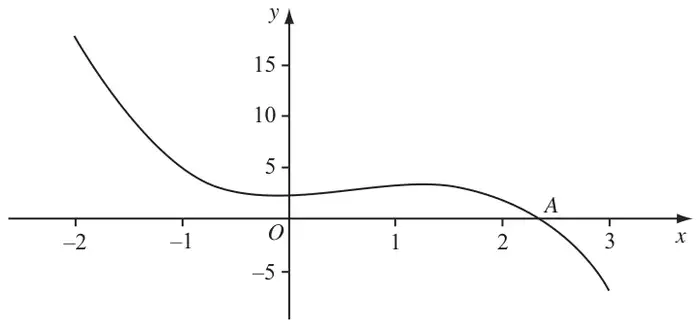
Figure 1 shows part of the curve with equation \(y = -x^3 + 2x^2 + 2\), which intersects the \(x\)-axis at the point \(A\) where \(x = \alpha\).
To find an approximation to \(\alpha\), the iterative formula
\[x_{n+1} = \frac{2}{(x_n)^2} + 2\]is used.
| Scheme | Marks |
|---|---|
| Iterative formula: \(x_{n+1} = \dfrac{2}{(x_n)^2} + 2\), \(x_0 = 2.5\) | |
| \(x_1 = \dfrac{2}{(2.5)^2} + 2\) | M1 |
| \(x_1 = 2.32\) \(x_2 = 2.371581451\ldots\) | A1 |
| \(x_3 = 2.355593575\ldots\) \(x_4 = 2.360436923\ldots\) | A1 cso |
| (3) |
Notes
M1: An attempt to substitute \(x_0 = 2.5\) into the iterative formula. Can be implied by \(x_1 = 2.32\) or 2.320
A1: Both \(x_1 = 2.32(0)\) and \(x_2 = \text{awrt } 2.372\)
A1 cso: Both \(x_3 = \text{awrt } 2.356\) and \(x_4 = \text{awrt } 2.360\) or 2.36
| Scheme | Marks |
|---|---|
| Let \(\mathrm{f}(x) = -x^3 + 2x^2 + 2 = 0\) | |
| \(\mathrm{f}(2.3585) = 0.00583577\ldots\) \(\mathrm{f}(2.3595) = -0.00142286\ldots\) | M1 dM1 |
| Sign change (and \(\mathrm{f}(x)\) is continuous) therefore a root \(\alpha\) is such that \(\alpha \in (2.3585, 2.3595) \Rightarrow \alpha = 2.359\ (3\text{ dp})\) | A1 |
| (3) | |
| (6 marks) |
Notes
M1: Choose suitable interval for \(x\), e.g. [2.3585, 2.3595] or tighter
dM1: any one value awrt 1 sf or truncated 1 sf
A1: both values correct, sign change and conclusion
At a minimum, both values must be correct to 1sf or truncated 1sf, candidate states “change of sign, hence root”.