
C4 June 2009 Q7
7. Relative to a fixed origin \(O\), the point \(A\) has position vector \((8\mathbf{i} + 13\mathbf{j} - 2\mathbf{k})\),
the point \(B\) has position vector \((10\mathbf{i} + 14\mathbf{j} - 4\mathbf{k})\),
and the point \(C\) has position vector \((9\mathbf{i} + 9\mathbf{j} + 6\mathbf{k})\).
The line \(l\) passes through the points \(A\) and \(B\).
(a) Find a vector equation for the line \(l\). (3)
(b) Find \(\left|\overrightarrow{CB}\right|\). (2)
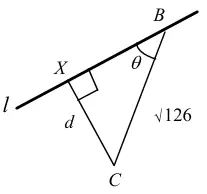
(c) Find the size of the acute angle between the line segment \(CB\) and the line \(l\), giving your answer in degrees to 1 decimal place. (3)
(d) Find the shortest distance from the point \(C\) to the line \(l\). (3)
The point \(X\) lies on \(l\). Given that the vector \(\overrightarrow{CX}\) is perpendicular to \(l\),
(e) find the area of the triangle \(CXB\), giving your answer to 3 significant figures. (3)
| Scheme | Marks |
|---|---|
| \(\overrightarrow{AB} = \overrightarrow{OB} - \overrightarrow{OA} = \begin{pmatrix}10\\14\\-4\end{pmatrix} - \begin{pmatrix}8\\13\\-2\end{pmatrix} = \begin{pmatrix}2\\1\\-2\end{pmatrix}\) or \(\overrightarrow{BA} = \begin{pmatrix}-2\\-1\\2\end{pmatrix}\) | M1 |
| \(\mathbf{r} = \begin{pmatrix}8\\13\\-2\end{pmatrix} + \lambda\begin{pmatrix}2\\1\\-2\end{pmatrix}\) or \(\mathbf{r} = \begin{pmatrix}10\\14\\-4\end{pmatrix} + \lambda\begin{pmatrix}2\\1\\-2\end{pmatrix}\) accept equivalents | M1 A1ft |
| (3) |
| Scheme | Marks |
|---|---|
| \(\overrightarrow{CB} = \overrightarrow{OB} - \overrightarrow{OC} = \begin{pmatrix}10\\14\\-4\end{pmatrix} - \begin{pmatrix}9\\9\\6\end{pmatrix} = \begin{pmatrix}1\\5\\-10\end{pmatrix}\) or \(\overrightarrow{BC} = \begin{pmatrix}-1\\-5\\10\end{pmatrix}\) | |
| \(CB = \sqrt{\left(1^2 + 5^2 + (-10)^2\right)} = \sqrt{(126)}\quad \left(= 3\sqrt{14} \approx 11.2\right)\) awrt 11.2 | M1 A1 |
| (2) |
| Scheme | Marks |
|---|---|
| \(\overrightarrow{CB}.\overrightarrow{AB} = \left|\overrightarrow{CB}\right|\left|\overrightarrow{AB}\right|\cos\theta\) | |
| \((\pm)(2 + 5 + 20) = \sqrt{126}\sqrt{9}\cos\theta\) | M1 A1 |
| \(\cos\theta = \dfrac{3}{\sqrt{14}} \Rightarrow \theta \approx 36.7^\circ\) awrt \(36.7^\circ\) | A1 |
| (3) |
| Scheme | Marks |
|---|---|
| \(\dfrac{d}{\sqrt{126}} = \sin\theta\) | M1 A1ft |
| \(d = 3\sqrt{5}\ (\approx 6.7)\) awrt 6.7 | A1 |
| (3) |
| Scheme | Marks |
|---|---|
| \(BX^2 = BC^2 - d^2 = 126 - 45 = 81\) | M1 |
| \(\triangle CBX = \dfrac{1}{2} \times BX \times d = \dfrac{1}{2} \times 9 \times 3\sqrt{5} = \dfrac{27\sqrt{5}}{2}\ (\approx 30.2)\) awrt 30.1 or 30.2 | M1 A1 |
| (3) | |
| (14 marks) |
Alternative for (e)
| \(\triangle CBX = \dfrac{1}{2} \times d \times BC\sin\angle XCB\) | M1 |
| \(= \dfrac{1}{2} \times 3\sqrt{5} \times \sqrt{126}\sin(90 - 36.7)^\circ\) sine of correct angle | M1 |
| \(\approx 30.2\) \(\dfrac{27\sqrt{5}}{2}\), awrt 30.1 or 30.2 | A1 |
| (3) |