
M2 June 2017 Q3
3.
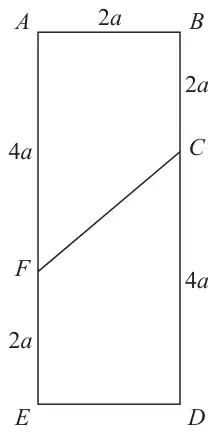
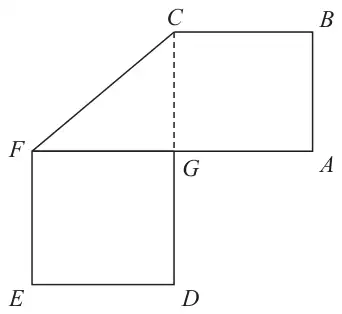
The uniform rectangular lamina \(ABDE\), shown in Figure 1, has side \(AB\) of length \(2a\) and side \(BD\) of length \(6a\). The point \(C\) divides \(BD\) in the ratio 1 : 2 and the point \(F\) divides \(EA\) in the ratio 1 : 2. The rectangular lamina is folded along \(FC\) to produce the folded lamina \(L\), shown in Figure 2.
The folded lamina, \(L\), is freely suspended from \(C\) and hangs in equilibrium.
| Scheme | Marks | |||||||||||||||
|---|---|---|---|---|---|---|---|---|---|---|---|---|---|---|---|---|
| B1 B1 | |||||||||||||||
| \(12d = 4a + 4 \times \dfrac{4}{3}a + 4 \times 3a\) | M1 A1 | |||||||||||||||
| \(12d = 16a \times \dfrac{4}{3},\ \ d = \dfrac{16}{9}a\) | A1 | |||||||||||||||
| (5) |
Notes
B1 Mass ratios. B1 Distances from \(EF\) or an alternative vertical axis
M1 Moments about \(EF\) or equivalent. Need all terms and dimensionally correct
A1 Correct unsimplified equation
A1 Sufficient working to justify *given answer*
3a alt
| Splitting the rectangle into a pair of trapeziums gives mass ratios 1: 1: 2 | B1 |
| Distance of c of m of ABCF is \(\dfrac{8}{9}a\) from AF and \(\dfrac{22}{9}a\) from EF | B1 |
| \(2a - a \times \dfrac{8}{9} + a \times \dfrac{22}{9}\left(= \dfrac{32}{9}a\right) = 2d\) | M1A1 |
| \(d = \dfrac{16}{9}a\) | A1 |
3a alt
Square -square -triangle+triangle
| B1 B1 | ||||||||||||||||||
| \(4 \times 2a - 3a - \dfrac{1}{2} \times \dfrac{2a}{3} + \dfrac{1}{2} \times \dfrac{4a}{3}\left(= \dfrac{16a}{3}\right) = 3d\) | M1A1 | ||||||||||||||||||
| \(d = \dfrac{16}{9}a\) | A1 |
| Scheme | Marks |
|---|---|
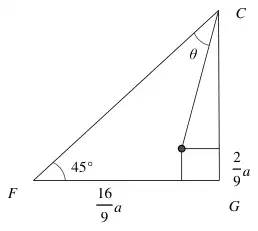
| Symmetry \(\Rightarrow\) c of m \(\dfrac{16}{9}a\) from \(C\) | B1 |
| \(\tan^{-1}\dfrac{1}{8}\ \ \left(\tan^{-1}8\right)\) | M1 |
| \(7.125^\circ\) | A1 |
| \(\theta = 37.9^\circ\) | A1 |
| (4) | |
| (9 marks) |
Notes
B1 For vertical distance – allow for \(\dfrac{20}{9}a\) or equivalent
M1 Correct trig to find relevant angle (using \(\dfrac{2}{9}a\) horizontally and their vertical \(\neq 2a\))
A1 \(\left(7.1^\circ, 82.9^\circ, 0.124\text{rads}, 1.45\text{rads}\right)\)
A1 38\(^\circ\) or better \(\left(37.874....^\circ,\ \ 0.66\text{ rads}\right)\)
3b alt
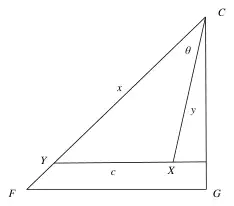 | |
| Symmetry \(\Rightarrow\) c of m \(\dfrac{2}{9}a\) from \(FG\) | B1 |
| \(\cos\theta = \dfrac{x^2 + y^2 - c^2}{2xy} = \dfrac{9}{\sqrt{130}} = 0.789...\) | M1A1 |
| \(\theta = 37.9^\circ\) | A1 (4) |
Using cosine rule With \(x = \dfrac{16}{9}\sqrt{2}a,\ c = \dfrac{14}{9}a\), \(y = \sqrt{65} \times \dfrac{2a}{9}\)
3balt
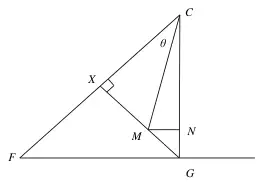 | |
| Symmetry \(\Rightarrow\) c of m \(\dfrac{2}{9}a\) from \(FG\) | B1 |
| \(\tan\theta = \dfrac{MX}{CX} = \dfrac{\sqrt{2}a - \frac{2\sqrt{2}}{9}a}{\sqrt{2}a} = \dfrac{7}{9}\) | M1A1 |
| \(\theta = 37.9^\circ\) | A1 (4) |
B1 i.e. on bisector of angle \(G\)
M1A1 Using Isosceles triangles