
C1 January 2007 Q9
9. Ann has some sticks that are all of the same length. She arranges them in squares and has made the following 3 rows of patterns:
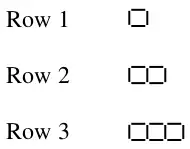
She notices that 4 sticks are required to make the single square in the first row, 7 sticks to make 2 squares in the second row and in the third row she needs 10 sticks to make 3 squares.
Ann continues to make squares following the same pattern. She makes 4 squares in the 4th row and so on until she has completed 10 rows.
Ann started with 1750 sticks. Given that Ann continues the pattern to complete \(k\) rows but does not have sufficient sticks to complete the \((k + 1)\)th row,
| Scheme | Marks |
|---|---|
| Recognising arithmetic series with first term 4 and common difference 3. (If not scored here, this mark may be given if seen elsewhere in the solution). | B1 |
| \(a + (n - 1)d = 4 + 3(n - 1) \qquad (= 3n + 1)\) | M1 A1 |
| (3) |
Notes
B1: Usually identified by \(a = 4\) and \(d = 3\).
M1: Attempted use of term formula for arithmetic series, or… answer in the form (\(3n\) + constant), where the constant is a non-zero value.
Answer for (a) does not require simplification, and a correct answer without working scores all 3 marks.
| Scheme | Marks |
|---|---|
| \(S_n = \dfrac{n}{2}\left\{2a + (n - 1)d\right\} = \dfrac{10}{2}\left\{8 + (10 - 1)\times 3\right\}, \quad = 175\), | M1 A1, A1 |
| (3) |
Notes
M1: Use of correct sum formula with \(n = 9\), 10 or 11.
A1: Correct, perhaps unsimplified, numerical version. A1: 175
Alternative: (Listing and summing terms).M1: Summing 9, 10 or 11 terms. (At least 1st, 2nd and last terms must be seen).
A1: Correct terms (perhaps implied by last term 31). A1: 175Alternative: (Listing all sums)
M1: Listing 9, 10 or 11 sums. (At least 4, 7, ….., “last”).
A1: Correct sums, correct finishing value 175. A1: 175Alternative: (Using last term).
M1: Using \(S_n = \dfrac{n}{2}(a + l)\) with \(T_9\), \(T_{10}\) or \(T_{11}\) as the last term.
A1: Correct numerical version \(\dfrac{10}{2}(4 + 31)\). A1: 175
Correct answer with no working scores 1 mark: 1,0,0.
| Scheme | Marks |
|---|---|
| \(S_k < 1750:\ \dfrac{k}{2}\left\{8 + 3(k - 1)\right\} < 1750 \quad \left(\text{or}\quad S_{k+1} > 1750:\ \dfrac{k + 1}{2}\left\{8 + 3k\right\} > 1750\right)\) | M1 |
| \(3k^2 + 5k - 3500 < 0 \quad \left(\text{or}\ \ 3k^2 + 11k - 3492 > 0\right)\) (Allow equivalent 3-term versions such as \(3k^2 + 5k = 3500\)). | M1 A1 |
| \((3k - 100)(k + 35) < 0\) Requires use of correct inequality throughout.(*) | A1cso |
| (4) |
Notes
For the first 3 marks, allow any inequality sign, or equals.
1st M: Use of correct sum formula to form inequality or equation in \(k\), with the 1750.
2nd M: (Dependent on 1st M). Form 3-term quadratic in \(k\).
1st A: Correct 3 terms.
Allow credit for part (c) if valid work is seen in part (d).
| Scheme | Marks |
|---|---|
| \(\dfrac{100}{3}\) or equiv. seen \(\left(\text{or}\ \dfrac{97}{3}\right)\), \(k = 33\) (and no other values) | M1, A1 |
| (2) | |
| (12 marks) |
Notes
Allow both marks for \(k = 33\) seen without working.
Working for part (d) must be seen in part (d), not part (c).