
June 2025 Paper 1 Q23
23 The diagram shows a trapezium.
All lengths are in centimetres.
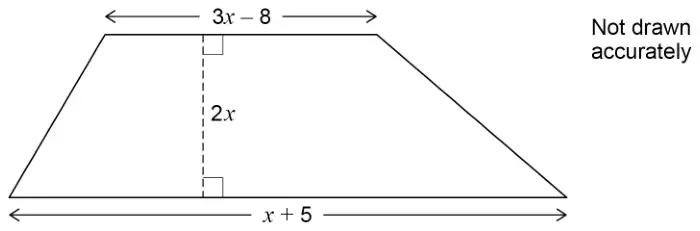
The area of the trapezium is less than 22 cm\(^2\)
Work out the greatest possible range of values of \(x\).
Give your answer in the form \(\quad m \lt x \lt n \quad\) where \(m\) and \(n\) are both positive numbers. [5 marks]
| Answer | Mark | Comments |
|---|---|---|
| (Area \(=\)) \(\dfrac{1}{2} \times (x + 5 + 3x - 8) \times 2x\) or \(4x^2 - 3x\) | M1 | |
| \(4x^2 - 3x - 22 \lt 0\) | M1dep | oe needs to be a quadratic \(\lt 0\) condone \(4x^2 - 3x \lt 22\) if completing the square |
| \((4x - 11)(x + 2)\) or \(\dfrac{3 \pm \sqrt{9 + 352}}{8}\) or \(4\left[\left(x - \dfrac{3}{8}\right)^2 - \dfrac{361}{64}\right]\) | M1 | must be from the correct quadratic oe could imply first 2 M marks if \(\lt 0\) seen |
| \((k \lt)\ x \lt 2\dfrac{3}{4}\) | A1 | oe for \(2\dfrac{3}{4}\) where \(k \lt 2\dfrac{3}{4}\) or \(k\) could be blank could imply M3A1 |
| \(2\dfrac{2}{3} \lt x\ \ (\lt k)\) | B1 | oe for \(2\dfrac{2}{3}\) where \(k \gt 2\dfrac{2}{3}\) or \(k\) could be blank |
Additional guidance
| Inequalities changed to \(=\) without being recovered correctly will have a maximum mark of M2 | M1M0M1A0B0 |
| Inequalities changed to \(=\) then recovered can score full marks | |
| Condone \((4x - 11)(4x + 8)\ (\lt 0)\) for third M mark |