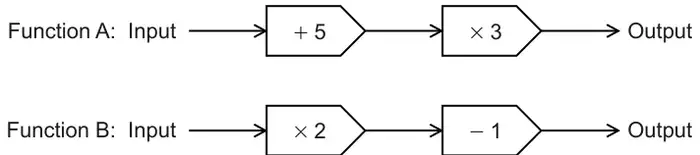
(a) Write an algebraic expression for the output of function A when the input is \(x\). [1]
(b) Here is a composite function C.
The input to function C is \(x\). The output from function C is \(2x + 1\).
Find the value of \(x\). You must show your working. [5]
Mark scheme (a)
Answer
Marks
Part marks and guidance
\(3(x + 5)\) oe final answer
1
Equivalent includes \(3x + 15\)
Mark scheme (b)
Answer
Marks
Part marks and guidance
\(-7\) with correct working
5
accept any correct method
B1 for [output = ] 2 × their{\(3(x + 5)\)} – 1 oe or output through inverse of B as \(x + 1\)
B1dep for their {2× \(3(x + 5)\) – 1} = \(2x + 1\) oe or output through inverse of A as \(\frac{x + 1}{3} - 5\) or \(x + 1\) = their {\(3(x + 5)\)}
M1 for e.g. their \(6x + 30 - 1 = 2x + 1\) or their \(3x = x + 1 - 15\) or inverse method \(\frac{x + 1}{3} - 5 = x\) M1 for their {\(4x = -28\) or \(-2x = 14\)} oe
Alternative method using trials M2 for at least two complete correct evaluations of both \(6x + 29\) oe(or functions) and \(2x + 1\) or M1 at least one complete correct evaluation of both \(6x + 29\) oe and \(2x + 1\)
If 0 or 1 scored SC3 for answer \(-7\) with no or insufficient working
“Correct working” requires evidence of at least B1B1 or B1M1 or M2 if using trials
B1 implied by \(2 \times 3(x + 5) - 1\) or better e.g. \(6x + 30 - 1\)
The first M1 is for dealing with bracket(s) correctly in a linear equation and the second M1 is for correctly getting the linear equation, with \(x\)’s on both sides, into the form \(ax = b\). We can only follow through an equation with \(x\)’s on both sides for M1 or \(x\)’s on both sides and a bracket for M2.