
Higher June 2021 Paper 2 Q5
5
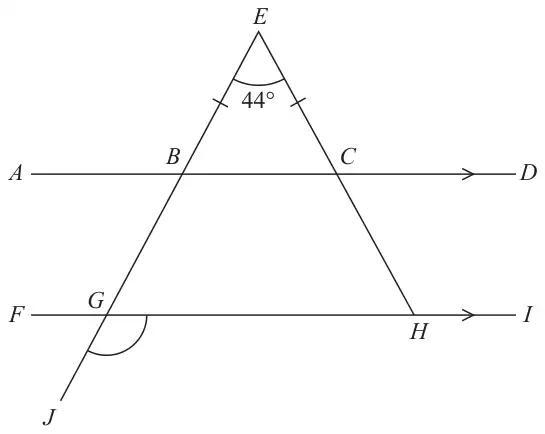
Diagram NOT accurately drawn
\(ABCD\) and \(FGHI\) are parallel straight lines.
\(EBGJ\) and \(ECH\) are straight lines.
\(BE = CE\)
Angle \(BEC = 44°\)
Work out the size of angle \(JGH\).
Give a reason for each stage of your working.
(5)
| Scheme | Marks |
|---|---|
| Angle \(EBC\) or \(ECB = (180 - 44) \div 2\ (= 68)\) | M1 |
| Angle \(GBC = 180 - \text{``}{68}\text{''}\ (= 112)\) or Angle \(GBC = \text{``}{68}\text{''} + 44\ (= 112)\) or Angle \(BGH = \text{``}{68}\text{''}\) (same as \(EBC\)) Angle \(ABE = 180 - \text{``}{68}\text{''}\ (= 112)\) and Angle \(BGF = \text{``}{112}\text{''}\) or Angle \(ABG = \text{``}{68}\text{''}\) and Angle \(BGH = \text{``}{68}\text{''}\) or Angle \(FGJ = \text{``}{68}\text{''}\) or Angle \(BGF = 180 - \text{``}{68}\text{''}\ (= 112)\) | M1 |
| Working not required, so correct angle scores 3 marks (unless from obvious incorrect working) Answer: 112 | A1 |
| NB: reasons must include the underlined words Accept ∠ for angle(s) and △ for triangle For all angles: They must be clearly stated as the correct angle or shown on the diagram in the correct position. (eg just seeing 68 in working without a label is not sufficient for the award of a mark for angle \(EBC\)) | B2 |
| (5) | |
| (5 marks) |
Notes
M1: Could be seen on diagram
M1: for a method to as far as one step away from working out Angle \(JGH\) (an angle corresponding or vertically opposite to \(JGH\) or at the same point on a straight line with \(JGH\))
Could be seen on diagram.
(the award of this mark also implies the previous M1)
A1: Could be seen in correct place on diagram
B2: for correct answer with full reasons for their method
eg isosceles triangle (or 2 equal sides, 2 equal angles)
Angles in a triangle sum to 180° or angles in a triangle
Angles on a straight line sum to 180°
Exterior angle in a triangle is equal to the two opposite interior angles.
Vertically opposite angles are equal.
Corresponding angles are equal.
Alternate angles are equal
Allied angles sum to 180° (or co-interior angles)
Angles at a point (or full turn) add up to 360° (or angles at a point)
(B1 for one correct reason appropriate to their method, dep on M1)