
Higher January 2021 Paper 1 Q23
23 \(OAB\) is a triangle.
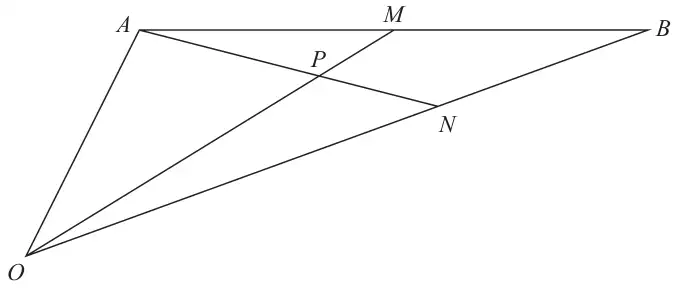
Diagram NOT accurately drawn
\(\overrightarrow{OA} = 2\mathbf{a}\) and \(\overrightarrow{OB} = 2\mathbf{b}\)
\(M\) is the midpoint of \(AB\).
\(N\) is the point on \(OB\) such that \(ON : NB = 2 : 1\)
\(P\) is the point on \(AN\) such that \(OPM\) is a straight line.
Use a vector method to find \(OP : PM\)
Show your working clearly.
(6)
| Scheme | Marks |
|---|---|
| \(\overrightarrow{AB} = 2\mathbf{b} - 2\mathbf{a}\) oe or \(\overrightarrow{BA} = 2\mathbf{a} - 2\mathbf{b}\) oe or \(\overrightarrow{AM} = \mathbf{b} - \mathbf{a}\) oe or \(\overrightarrow{MA} = \mathbf{a} - \mathbf{b}\) oe or \(\overrightarrow{BM} = \mathbf{b} - \mathbf{a}\) oe or \(\overrightarrow{MB} = \mathbf{a} - \mathbf{b}\) oe | M1 |
e.g. \(\overrightarrow{OM} = 2\mathbf{a} + (\mathbf{b} - \mathbf{a})\;(= \mathbf{a} + \mathbf{b})\) oe or \(\overrightarrow{MO} = (\mathbf{b} - \mathbf{a}) - 2\mathbf{b}\;(= -\mathbf{a} - \mathbf{b})\) oe or \(\overrightarrow{AN} = \dfrac{4}{3}\mathbf{b} - 2\mathbf{a}\) oe or \(\overrightarrow{NA} = 2\mathbf{a} - \dfrac{4}{3}\mathbf{b}\) oe | M1 |
e.g. \(\overrightarrow{OP} = 2\mathbf{a} + \lambda\left(\dfrac{4}{3}\mathbf{b} - 2\mathbf{a}\right)\) oe or \(\overrightarrow{OP} = \dfrac{4}{3}\mathbf{b} + \lambda\left(2\mathbf{a} - \dfrac{4}{3}\mathbf{b}\right)\) oe or \(\overrightarrow{OP} = \mu(\mathbf{a} + \mathbf{b})\) oe OR \(\overrightarrow{MP} = \mathbf{a} - \mathbf{b} + k\left(\dfrac{4}{3}\mathbf{b} - 2\mathbf{a}\right)\) oe or \(\overrightarrow{MP} = \mathbf{b} - \mathbf{a} - \dfrac{2}{3}\mathbf{b} + k\left(2\mathbf{a} - \dfrac{4}{3}\mathbf{b}\right)\) oe or \(\overrightarrow{MP} = t(-\mathbf{a} - \mathbf{b})\) oe | M1 |
e.g. \(2\mathbf{a} + \lambda\left(\dfrac{4}{3}\mathbf{b} - 2\mathbf{a}\right) = \mu(\mathbf{a} + \mathbf{b})\) oe or \(\dfrac{4}{3}\mathbf{b} + \lambda\left(2\mathbf{a} - \dfrac{4}{3}\mathbf{b}\right) = \mu(\mathbf{a} + \mathbf{b})\) oe or \(\mathbf{a} - \mathbf{b} + k\left(\dfrac{4}{3}\mathbf{b} - 2\mathbf{a}\right) = t(-\mathbf{a} - \mathbf{b})\) oe or \(\mathbf{b} - \mathbf{a} - \dfrac{2}{3}\mathbf{b} + k\left(2\mathbf{a} - \dfrac{4}{3}\mathbf{b}\right) = t(-\mathbf{a} - \mathbf{b})\) oe | M1 |
| \(\mu = \dfrac{4}{5}\) or \(t = \dfrac{1}{5}\) | M1 |
| Working required Answer: 4 : 1 | A1 |
| (6) | |
| (6 marks) |
Notes
M1: for finding \(\overrightarrow{AB}\) or \(\overrightarrow{BA}\) or \(\overrightarrow{AM}\) or \(\overrightarrow{MA}\) or \(\overrightarrow{BM}\) or \(\overrightarrow{MB}\)
M1: for finding \(\overrightarrow{OM}\) or \(\overrightarrow{MO}\) or \(\overrightarrow{AN}\) or \(\overrightarrow{NA}\)
M1: for finding \(\overrightarrow{OP}\) or \(\overrightarrow{PO}\) or \(\overrightarrow{MP}\) or \(\overrightarrow{PM}\)
M1: for setting up an equation for \(\overrightarrow{OP}\) or \(\overrightarrow{MP}\)
M1: for finding \(\mu\) or \(t\) for either \(\overrightarrow{OP} = \mu\overrightarrow{OM}\)
or \(\overrightarrow{MP} = t\overrightarrow{MO}\)
A1: cao (dep on M3)