
Foundation June 2025 Paper 3 Q19
19 The diagram shows two similar cuboids, X and Y.
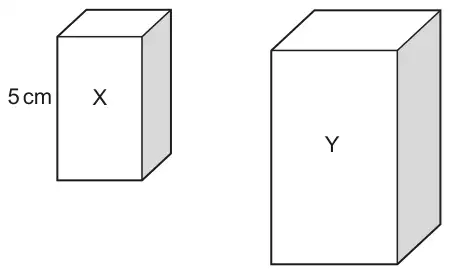
Not to scale
Cuboid X has a square base with area 16 cm\(^2\) and height 5 cm.
Cuboid Y has a square base with area 36 cm\(^2\).
Work out the height of cuboid Y.
You must show your working. [4]
| Answer | Marks | Part marks and guidance | |
|---|---|---|---|
| 7.5 with correct working | 4 | Correct working requires M3 or B2M1 If working in rounded decimals with 2 dp seen allow M marks but A0 if 7.5 rounded from inexact value May be implied by [5] \(\times\) 1.5 or e.g. as arrow from X to Y with “\(\times\) 1.5” on it or, in parts e.g. \(5 \times 6 = k\) then \(k \div 4\) | |
| M3 for \(5 \times \dfrac{6}{4}\) oe or \(5 \div \dfrac{4}{6}\) oe | |||
| OR | |||
| B2 for [base lengths] 4 and 6 or B1 for [base lengths] 4 or 6 and M1 for \(5 \times \dfrac{\textit{their}\ 6}{\textit{their}\ 4}\) oe or \(5 \div \dfrac{\textit{their}\ 4}{\textit{their}\ 6}\) oe | May be on diagram 4 and 6 not number of edges so \(16 \div 4\) and \(36 \div 4\) score B0 or base edges 4 and 9 score B0 Their 4 and their 6 are their chosen base lengths and not 16 and 36 | ||
| If 0 scored, SC1 for answer 7.5 with no or insufficient working | Alternative M2 for [length factor] \(\sqrt{\dfrac{36}{16}}\) or \(\dfrac{6}{4}\) oe or \(\sqrt{\dfrac{16}{36}}\) or \(\dfrac{4}{6}\) oe or M1 for area factor oe = \(\dfrac{36}{16}\) oe or \(\dfrac{16}{36}\) oe M1 for \(5 \times \dfrac{\textit{their}\ 6}{\textit{their}\ 4}\) oe or \(5 \div \dfrac{\textit{their}\ 4}{\textit{their}\ 6}\) oe | ||