
Foundation January 2019 Paper 2 Q13
13
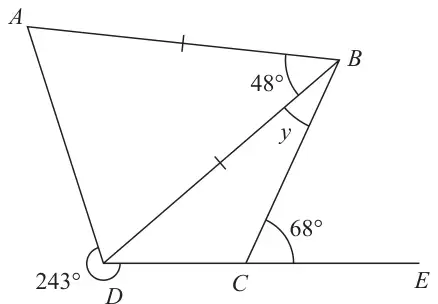
Diagram NOT accurately drawn
\(ABD\) is an isosceles triangle with \(AB = DB\).
\(DCE\) is a straight line.
Angle \(ABD\) = 48°
Angle \(BCE\) = 68°
Reflex angle \(ADC\) = 243°
Work out the size of the angle marked \(y\).
Give a reason for each stage in your working.
(5)
| Scheme | Marks |
|---|---|
| Angle \(BCD\) = 180 – 68 (= 112) or angle \(BAD\) (or \(BDA\)) = (180 – 48) ÷ 2 (= 66) | M1 |
| angle \(BDC\) = 360 – 243 – “66” (= 51) or angle \(ADC\) = 360 – 243 (= 117) | M1 |
| e.g. 68 – “51” (= 17) or 180 – (180 – 68) – “51” or 360 – “117” – “66” – (180 – 68) – 48 | M1 |
| B1 | |
| 17 with reasons | A1 |
| (5) | |
| (5 marks) |
Notes
M1: Could be seen on diagram
M1: Could be seen on diagram
M1: for a complete method
B1: dep on M1 for any one correct appropriate reason
A1: for correct answer with full reasons
E.g.
Base angles of an isosceles triangle are equal
Angles in a triangle sum to 180°
Angles at a point add up to 360° / full turn
Angles on a straight line sum to 180° or exterior angle equals the sum of interior opposite angles
Angles in a quadrilateral add up to 360°