
Higher June 2025 Paper 4 Q13
13 A, B, and C are points on a circle, centre O.
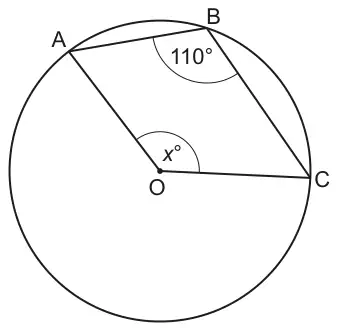
Not to scale
(a) Explain why OABC is not a cyclic quadrilateral. [1]
(b) Work out the value of \(x\). [2]
| Answer | Marks | Part marks and guidance | |
|---|---|---|---|
| O is not on the circumference oe | 1 | see appendix | |
Appendix: exemplar responses for Q13(a)
| Response | Mark |
|---|---|
| O is not on the circumference | 1 |
| Not all the ends of the quadrilateral touch the sides of the circle | 1(BOD) |
| Not all 4 points of the quadrilateral touch the circumference of the circle | 1 |
| Each point/angle/corners is not touching the circle | 1 |
| Point AOC does not touch the circumference | 1 |
| It should touch the circle 4 times | 1 |
| Not all corners touch the perimeter of the circle | 1 |
| It does not cover the whole of the diameter only the radius | 0 |
| Opposite angles are not supplementary | 0 |
| It does not touch the circle | 0 |
| All the points do not touch the arcs | 0 |
| All corners do not touch the edge | 0 |
| The point where A and C meet does not touch the perimeter (needs AO and CO and perimeter of the circle) | 0 |
| It meets at the centre of the circle | 0 |
| One point connects at the centre | 0 |
| Answer | Marks | Part marks and guidance | |
|---|---|---|---|
| 140 | 2 | M1 for reflex angle AOC = 220 or for \(360 - 2 \times 110\) | May be on diagram Award M1 for other valid method reaching the equivalent of a correct equation in \(x\) e.g. Point D added on major arc, ADC indicated as \(\frac{x}{2}\) and then \(110 + \frac{x}{2} = 180\) oe or marking angle ADC as 70 |