
Foundation January 2020 Paper 1 Q4
4 Here is a sequence of patterns made from square tiles.
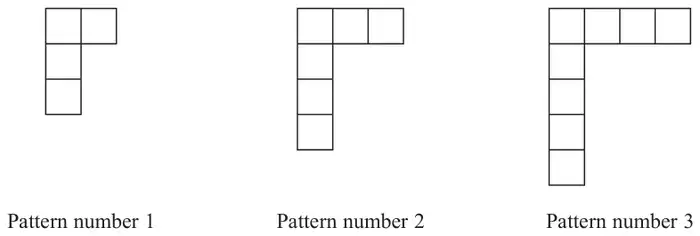
(a) In the space below, draw Pattern number 4 (1)
(b) Complete the table.
(1)
| Pattern number | 1 | 2 | 3 | 4 | 5 |
|---|---|---|---|---|---|
| Number of tiles | 4 | 6 | 8 |
(c) Work out the number of tiles in Pattern number 30 (2)
Liz says that in Pattern number \(n\), the number of tiles is \(2n\).
(d) Is Liz correct?
You must give a reason for your answer. (1)
You must give a reason for your answer. (1)
| Scheme | Marks |
|---|---|
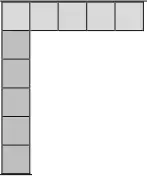 Answer: pattern 4 drawn | B1 |
| (1) |
| Scheme | Marks |
|---|---|
| 10, 12 | B1 |
| (1) |
| Scheme | Marks |
|---|---|
| 14, 16, 18, 20, 22, 24, 26, 28, 30, 32 or 2 × 30 + 2 or 12 + (25 × 2) or 4 + (29 × 2) or 31 × 2 or uses or states \(2n + 2\) | M1 |
| 62 | A1 |
| (2) |
Notes
M1: for adding 2 and continuing to at least pattern 15 (allow one error) or for a correct diagram or any correct method which would lead to 62
| Scheme | Marks |
|---|---|
| E.g. \(n\)th term is \(2n + 2\) oe or gives a counter example e.g. when \(n = 1\), \(2n\) gives 2 (not 4) Answer: No with reason | B1 |
| (1) | |
| (5 marks) |
Notes
B1: oe