
Higher June 2019 Paper 2 Q18
18 The points \(A\), \(B\), \(C\) and \(D\) lie on a circle.
\(CDE\) is a straight line.
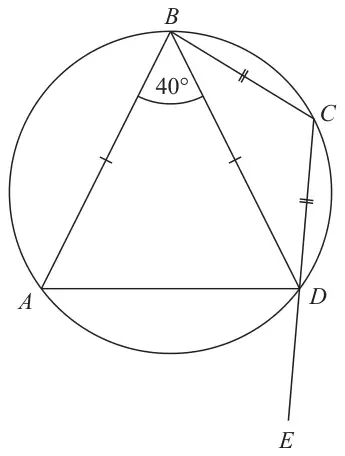
\(BA = BD\)
\(CB = CD\)
Angle \(ABD = 40^\circ\)
Work out the size of angle \(ADE\).
You must give a reason for each stage of your working. (5)
| Answer | Mark | Mark scheme |
|---|---|---|
| \(75^\circ\) with reasons | M1 | for finding angle \(BAD = \dfrac{180 - 40}{2}\ (= 70)\) or angle \(BDA = \dfrac{180 - 40}{2}\ (= 70)\) |
| M1 | for finding angle \(BCD = 180 - \text{``}70\text{''}\ (= 110)\) or \(40 + x + 70 + x = 180\) | |
| A1 | for finding angle \(ADE = 75\) | |
| C2 | (dep M2) for “Opposite angles of a cyclic quadrilateral add up to 180” and one other reason; all reasons given must be appropriate for their working. Other reasons: Base angles of an isosceles triangle are equal Angles in a triangle add up to 180 Angles on a straight line add up to 180 [or exterior angle of a cyclic quadrilateral is equal to the interior opposite angle] | |
| (C1 | (dep M2) for “Opposite angles of a cyclic quadrilateral add up to 180” or all other reasons given appropriate for their working) |
Additional guidance
Could be shown on the diagram or in working
Underlined words need to be shown; reasons need to be linked to their method
Apply the above criteria