
Higher June 2018 Paper 2 Q13
13
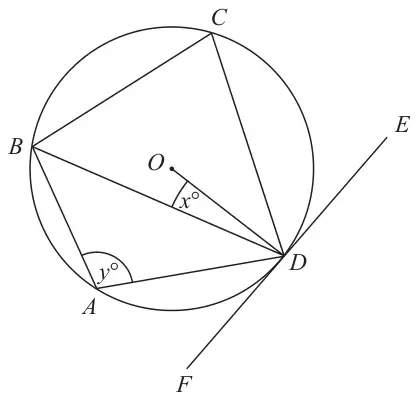
\(A\), \(B\), \(C\) and \(D\) are points on the circumference of a circle, centre \(O\).
\(FDE\) is a tangent to the circle.
(a) Show that \(y - x = 90\)
You must give a reason for each stage of your working. (3)
You must give a reason for each stage of your working. (3)
Dylan was asked to give some possible values for \(x\) and \(y\).
He said,
“\(y\) could be 200 and \(x\) could be 110, because \(200 - 110 = 90\)”
(b) Is Dylan correct?
You must give a reason for your answer. (1)
You must give a reason for your answer. (1)
| Answer | Mark | Mark scheme |
|---|---|---|
| Shown | M1 | for finding one missing angle eg \(BDE = y\) or \(ODE = 90\) or \(ODF = 90\) or \(DBO = x\) or \(BCD = 180 - y\) or (reflex) \(BOD = 2y\) |
| A1 | for a complete correct method leading to \(y - x = 90\) | |
| C1 | (dep on A1) for all correct circle theorems given appropriate for their working eg The tangent to a circle is perpendicular (90°) to the radius (diameter) Alternate segment theorem OR Angle at the centre is twice the angle at the circumference Opposite angles in a cyclic quadrilateral sum to 180° |
Additional guidance
Could be shown on the diagram or in working
| Answer | Mark | Mark scheme |
|---|---|---|
| Explanation | C1 | for explanation eg No as \(y\) must be less than 180 as it is an angle in a triangle |