
Foundation November 2017 Paper 3 Q7
7
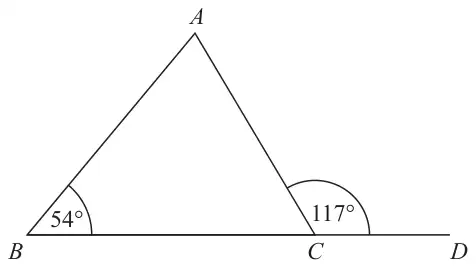
\(BCD\) is a straight line.
\(ABC\) is a triangle.
Show that triangle \(ABC\) is an isosceles triangle.
Give a reason for each stage of your working. (4)
| Answer | Mark | Notes |
|---|---|---|
| shown | M1 | for (angle \(BCA\)) \(= 180 - 117\ (= 63)\) |
| M1 | for (angle \(CAB\)) \(= 180 - \text{``}63\text{''} - 54\ (= 63)\) or (angle \(CAB\)) \(= 117 - 54\ (= 63)\) | |
| C2 | for statement, eg. isosceles since angle \(BCA =\) angle \(CAB = 63\) with fully correct reasons, from: angles on a straight line add up to 180° angles in a triangle add up to 180° exterior angle of a triangle is equal to sum of interior opposite angles | |
| [C1 | for angle \(BCA = 63\) and angle \(CAB = 63\) and one of the above reasons] | |
| OR | ||
| M1 | for \(\dfrac{(180 - 54)}{2}\ (= 63)\) | |
| M1 | for identification of two angles in triangle \(ABC\) being “63” | |
| C2 | for statement, eg. isosceles since angle \(BCA =\) angle \(CAB = 63\) and angles on a straight line add up to 180° and fully correct reasons: base angles of an isosceles triangle are equal and angles in a triangle add up to 180° | |
| [C1 | for angle \(BCA = 63\) and angle \(CAB = 63\) and one reason from: base angles of an isosceles triangle are equal angles in a triangle add up to 180°] |