
Foundation November 2021 Paper 2 Q30
30 \(A\), \(B\) and \(C\) are three points on a circle.
The radii from \(A\), \(B\) and \(C\) are shown.
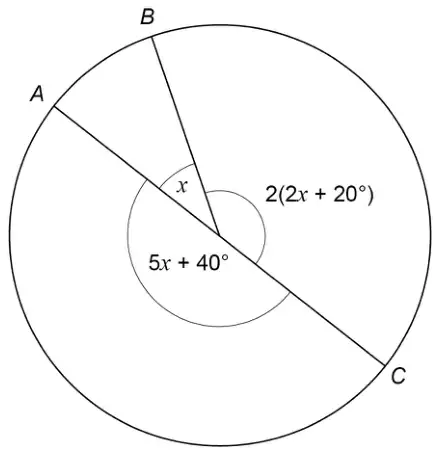
Not drawn accurately
Is \(AC\) a diameter of the circle?
You must show your working. [3 marks]
| Answer | Mark | Comments |
|---|---|---|
| Alternative method 1 Shows algebraically that the angles are equal | ||
| \(4x + 40\) | M1 | may be embedded or on the diagram |
| \(x + 2(2x + 20)\) or \(x + 4x + 40\) | M1 | |
| \(x + 4x + 40 = 5x + 40\) and Yes | A1 | |
| Alternative method 2 Derives and solves an equation for angles at a point and substitutes into \(5x + 40\) or \(x + 2(2x + 20)\) | ||
| \(4x + 40\) | M1 | may be embedded or on the diagram or implied eg implied by \(10x + 80 = 360\) |
| \(x + 2(2x + 20) + 5x + 40 = 360\) or \(x + 4x + 40 + 5x + 40 = 360\) or \((x =)\) 28 | M1 | oe equation eg \(10x + 80 = 360\) \((x =)\) 28 may be on the diagram |
| \(140 + 40 = 180\) and Yes or \(28 + 152 = 180\) and Yes | A1 | oe must obtain \((x =)\) 28 from one expression and substitute \((x =)\) 28 into a different expression |
| Alternative method 3 Assumes line is a diameter. Derives and solves an equation for angles on a line using \(5x + 40\) and substitutes into \(x + 2(2x + 20)\) or \(x + 2(2x + 20) + 5x + 40\) | ||
| \(5x + 40 = 180\) | M1 | |
| \((x =)\ (180 - 40) \div 5\) or \((x =)\) 28 | M1dep | oe \((x =)\) 28 may be on the diagram |
| \(28 + 152 = 180\) and Yes or \(28 + 152 + 140 + 40 = 360\) and Yes | A1 | oe must obtain \((x =)\) 28 from one expression and substitute \((x =)\) 28 into a different expression |
| Alternative method 4 Assumes line is a diameter. Derives and solves an equation for angles on a line using \(x + 2(2x + 20)\) and substitutes into \(5x + 40\) or \(x + 2(2x + 20) + 5x + 40\) | ||
| \(x + 2(2x + 20) = 180\) or \(x + 4x + 40 = 180\) | M1 | |
| \((x =)\ (180 - 40) \div 5\) or \((x =)\) 28 | M1dep | oe \((x =)\) 28 may be on the diagram |
| \(140 + 40 = 180\) and Yes or \(28 + 152 + 140 + 40 = 360\) and Yes | A1 | oe must obtain \((x =)\) 28 from one expression and substitute \((x =)\) 28 into a different expression |
| Alternative method 5 Assumes line is a diameter. Derives and solves two equations for angles on a line/angles at a point | ||
| \(5x + 40 = 180\) or \(x + 2(2x + 20) = 180\) or \(x + 4x + 40 = 180\) or \(x + 2(2x + 20) + 5x + 40 = 360\) or \(x + 4x + 40 + 5x + 40 = 360\) | M1 | |
| \((x =)\ (180 - 40) \div 5\) or \((x =)\) 28 | M1dep | oe \((x =)\) 28 may be on the diagram |
| Obtains \((x =)\) 28 from two equations for angles on a line/angles at a point and Yes | A1 | |
Additional guidance
| Choose the scheme that favours the student | |
| Up to M2 may be awarded for correct work, with no or incorrect answer, even if this is seen amongst multiple attempts | |
| Correct response with other incorrect work | M1M1A0 |
| Alt 1 \(2(2x + 20) = 4x + 20\) followed by \(x + 4x + 20\) Alt 1 \(x + 4x + 20\) with \(2(2x + 20) = 4x + 20\) not seen Apply marks in a similar way in alts 2, 4 and 5 | M0M1 M0M0 |
| \((x =)\) 28 | M1M1 |
| Allow \((x =)\) 28 to be embedded | M1M1 |
| No method marks scored with a value of \(x\) \((\ne 28)\) substituted into \(5x + 40\) and \(x + 2(2x + 20)\) giving the same value | M0M0A0 |
| Yes can be implied eg Alt 1 \(x + 4x + 40 = 5x + 40\) and It is a diameter | M1M1A1 |