
Higher June 2019 Paper 1 Q25
25 \(P\,(4, 8)\) is a point on a circle, centre \(O\).
The tangent at \(P\) intersects the axes at points \(A\) and \(B\).
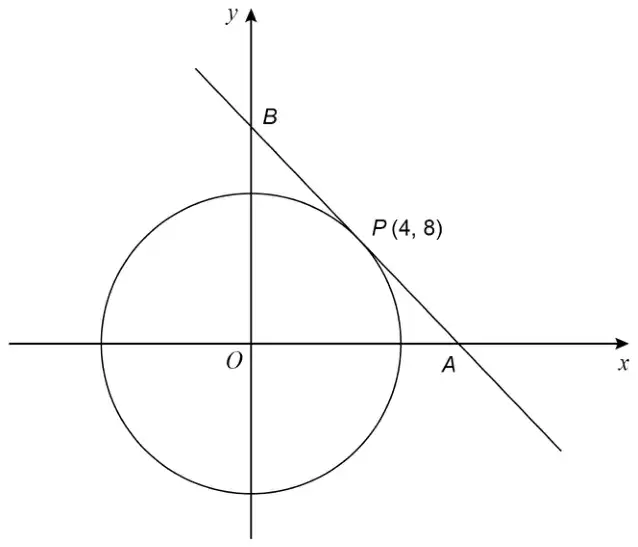
Not drawn accurately
(a) Show that the gradient of the tangent is \(-\dfrac{1}{2}\) [2 marks]
(b) Work out the length \(AB\).
Give your answer in the form \(\quad a\sqrt{5} \quad\) where \(a\) is an integer.
You must show your working. [4 marks]
| Answer | Mark | Comments |
|---|---|---|
| (gradient of \(OP\) =) \(\dfrac{8 - 0}{4 - 0}\) | M1 | oe eg (gradient of \(OP\) =) \(\dfrac{8}{4}\) |
| (gradient of \(OP\) =) 2 or \(\dfrac{2}{1}\) and \(-1 \div 2 = -\dfrac{1}{2}\) or \(2 \times -\dfrac{1}{2} = -1\) with M1 seen | A1 | oe accept ‘negative reciprocal, so \(-\dfrac{1}{2}\)’ or ‘product of gradients is \(-1\), so \(-\dfrac{1}{2}\)’ oe comment |
Additional guidance
| \(4 \div 8 = \dfrac{1}{2}\) but slope is negative, so \(-\dfrac{1}{2}\) | M0A0 |
| Do not accept a gradient including \(x\) eg \(\dfrac{8}{4} = 2\), so gradient of \(OP = 2x\), product of gradients is \(-1\), so \(-\dfrac{1}{2}x\) | M1A0 |
| Answer | Mark | Comments |
|---|---|---|
| Alternative method 1: \(y = -\dfrac{1}{2}x + c\) and substitutes 8 and 4 | ||
| \(8 = -\dfrac{1}{2} \times 4 + c\) or \((c =)\ 10\) | M1 | oe implied by \(y = -\dfrac{1}{2}x + 10\) |
| \(0 = -\dfrac{1}{2}x\) + their 10 or \((x =)\ 20\) | M1dep | oe |
| their \(20^2\) + their \(10^2\) or 500 or \(\sqrt{500}\) | M1dep | oe eg \(2\sqrt{125}\) dep on M2 |
| \(10\sqrt{5}\) | A1 | accept \(a = 10\) with \(\sqrt{500}\) seen |
| Alternative method 2: uses the formula for a line and substitutes \(x = 0\) and \(y = 0\) | ||
| \(y - 8 = -\dfrac{1}{2}(x - 4)\) and substitutes \(x = 0\) or \(y = 0\) or \((x =)\ 20\) or \((y =)\ 10\) | M1 | oe equation eg \(x + 2y = 20\) |
| \(y - 8 = -\dfrac{1}{2}(x - 4)\) and substitutes \(x = 0\) and substitutes \(y = 0\) or \((x =)\ 20\) and \((y =)\ 10\) | M1 | oe equation eg \(x + 2y = 20\) |
| their \(20^2\) + their \(10^2\) or 500 or \(\sqrt{500}\) | M1dep | oe eg \(2\sqrt{125}\) dep on M2 |
| \(10\sqrt{5}\) | A1 | accept \(a = 10\) with \(\sqrt{500}\) seen |
| Alternative method 3: uses formula for gradient with points \(A\) and \(B\) | ||
| \(\dfrac{8 - 0}{4 - x} = -\dfrac{1}{2}\) or \((x =)\ 20\) | M1 | oe correct method to work out the \(x\)-coordinate of point \(A\) |
| \(\dfrac{y - 8}{0 - 4} = -\dfrac{1}{2}\) or \((y =)\ 10\) | M1 | oe correct method to work out the \(y\)-coordinate of point \(B\) |
| their \(20^2\) + their \(10^2\) or 500 or \(\sqrt{500}\) | M1dep | oe eg \(2\sqrt{125}\) dep on M2 |
| \(10\sqrt{5}\) | A1 | accept \(a = 10\) with \(\sqrt{500}\) seen |
Additional guidance
| Check the diagram and 25(a) for possible correct working or values eg 1 20 marked on axis at \(A\) eg 2 10 marked on axis at \(B\) | M1 M1 |
| On alternative method 2, if using \(y - 8 = -\dfrac{1}{2}(x - 4)\), they must substitute \(x = 0\) or \(y = 0\) for M1 and both separately for M1M1 | |
| On alternative method 2, incorrect rearrangement of \(y - 8 = -\dfrac{1}{2}(x - 4)\) can score up to 3 marks eg \(y - 8 = -\dfrac{1}{2}(x - 4)\), \(2y - 8 = -x - 4\), when \(y = 0\), \(x = 4\), when \(x = 0\), \(y = 2\), \(\sqrt{4^2 + 2^2} = \sqrt{20}\) | M1M1M1 |