
Higher November 2019 Paper 2 Q23
23 Here are three similar cuboids, A, B and C.
A has length 5 cm, width 2 cm and height 3 cm
B has length 10 cm
C has length \(x\) cm
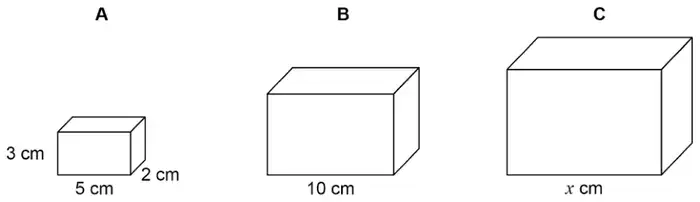
(a) The total surface area of A is 62 cm2
Tim wants to work out the total surface area of B.
Here is his working.
| \(10 \div 5 = 2\) \(62 \times 2 = 124\) Total surface area of B = 124 cm2 |
Make one criticism of Tim’s method. [1 mark]
(b) Volume of A \(\times \dfrac{125}{8} =\) Volume of C
Work out the value of \(x\). [3 marks]
| Answer | Mark | Comments |
|---|---|---|
| Valid criticism | B1 | eg the scale factor should be 4 or surface area is 248 cm2 |
Additional guidance
| sf = \(2^2\) | B1 |
| \(62 \times 4\) | B1 |
| \(62 \times 2^2\) | B1 |
| The area is 248 (ignore units) | B1 |
| Should be \(2 \times 10 \times 6 + 2 \times 10 \times 4 + 2 \times 6 \times 4\) | B1 |
| Condone It should be 4 | B1 |
| 4 | B0 |
| He should have multiplied all lengths by 2 | B0 |
| It should be \(10 \times 4 \times 6\) | B0 |
| Answer | Mark | Comments |
|---|---|---|
| Alternative method 1 | ||
| \(\sqrt[3]{\dfrac{125}{8}}\) or \(\dfrac{5}{2}\) or \(\sqrt[3]{\dfrac{8}{125}}\) or \(\dfrac{2}{5}\) | M1 | oe eg \(\sqrt[3]{15.625}\) or 2.5 or \(\sqrt[3]{0.064}\) or 0.4 |
| \(5 \times \sqrt[3]{\dfrac{125}{8}}\) or \(5 \div \sqrt[3]{\dfrac{8}{125}}\) | M1dep | oe |
| 12.5 or \(12\dfrac{1}{2}\) or \(\dfrac{25}{2}\) | A1 | |
| Alternative method 2 | ||
| \(5 \times 3 \times 2 \times \dfrac{125}{8}\) or 468.75 | M1 | oe eg \(5 \times 3 \times 2 \times 15.625\) or \(30 \times \dfrac{125}{8}\) |
| \(x \times \dfrac{3x}{5} \times \dfrac{2x}{5} =\) their 468.75 | M1dep | oe eg \(\dfrac{6}{25}x^3 =\) their 468.75 |
| 12.5 or \(12\dfrac{1}{2}\) or \(\dfrac{25}{2}\) | A1 | |
Additional guidance
| \(\sqrt{\dfrac{125}{8}}\) or \(\sqrt{\dfrac{8}{125}}\) | M0M0A0 |
| \(x \times \dfrac{x}{5/3} \times \dfrac{x}{5/2} =\) their 468.75 | M1M1 |
| Allow 1.66 or 1.67 for \(\dfrac{5}{3}\) eg \(x \times \dfrac{x}{1.66} \times \dfrac{x}{2.5} =\) their 468.75 | M1M1 |