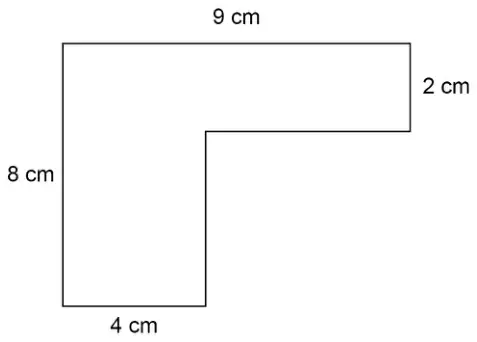
The 2nd M is for a complete method that would lead to an answer of 42 eg \(9 \times 2 = 18\), \(6 \times 4 = 24\), \(18 + 24 = 42\), then \(42 \div 2 = 21\)
M1M0
Beware eg \(8 + 4 + 8 + 4 = 24\) which is M0 without a correct area seen
M0
Ignore any units given with answer
Mark scheme (b)
Answer
Mark
Comments
Valid criticism
B1
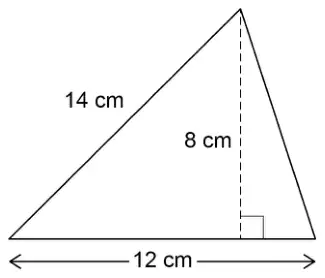
eg the formula is \(\dfrac{1}{2} \times \text{base} \times \text{height}\) or the answer is double the correct answer or he has forgotten the \(\dfrac{1}{2}\) or it should be \(\dfrac{1}{2} \times 12 \times 8\) or it should be 48
Additional guidance
He needs to halve 12 (which is 6, \(6 \times 8 = 48\))
B1
He hasn’t halved the base
B1
\(0.5 \times 12 \times 8 = 48\)
B1
His method was to work out a rectangle (insufficient)
B0
He should divide by half
B0
He didn’t use the area of a triangle formula
B0
He should have timesed all the measurements and divided by 2
B0
Ignore irrelevant statements alongside a correct statement eg1 he has forgotten to divide by 2, the base should be shorter eg2 should have divided by 2, he worked out the area of a rectangle
B1 B1
Two statements, one correct, one incorrect eg1 he has forgotten to divide by 2, it should be \(14 \times 8 \div 2\) eg2 should have divided by 2, he worked out the area of a square eg3 forgot to halve the base, should have been \(6 \times 8 = 49\)