
Foundation November 2019 Paper 2 Q29
29 The diagram shows a cube and a cuboid.
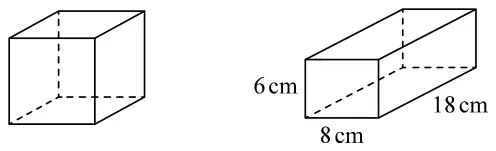
The total surface area of the cube is equal to the total surface area of the cuboid.
Janet says,
“The volume of the cube is equal to the volume of the cuboid.”
Is Janet correct?
You must show how you get your answer. (5)
| Answer | Mark | Mark scheme |
|---|---|---|
| No (supported) | P1 | for finding the area of 3 or more faces of the cuboid and adding eg \((6 \times 8) + (8 \times 18) + (6 \times 18) \ldots\) or \(\text{``}48\text{''} + \text{``}144\text{''} + \text{``}108\text{''} \ldots\ (= 300)\) |
| P1 | complete process to find surface area of cuboid, eg \(6 \times 8 \times 2 + 6 \times 18 \times 2 + 8 \times 18 \times 2\ (= 600)\) | |
| P1 | for process to find side length of cube, eg [surface area] \(\div\ 6\) and square rooting \((= 10)\) OR for a process to find the volume of the cuboid \(6 \times 8 \times 18\ (= 864)\) and cube rooting \((= 9.52...)\) to find a side length | |
| P1 | (dep on previous P1) for processes to find volume of cube and volume of cuboid, eg [side length]\(^3\ (= 1000)\) and \(6 \times 8 \times 18\ (= 864)\) OR (dep on previous P1) for process to find surface area of cube, eg. \((\text{``}9.52...\text{''})^2 \times 6\ (= 544.28...)\) | |
| A1 | No with 1000 and 864 OR No with 600 and 544(.28...) |
Additional guidance
Could be an addition of any three faces eg 48 + 48 + 144 etc.
[surface area] must come from the addition of at least three attempts at area, but not from volume.
The third and fourth marks are printed in two columns: the first method in each of those rows goes with the first method in the other, and the method after OR goes with the method after OR.