
A2 June 2019 Q7
7. A transformation from the \(z\)-plane to the \(w\)-plane is given by
\[w = \frac{3\mathrm{i}z - 2}{z + \mathrm{i}} \qquad z \ne -\mathrm{i}\]| Scheme | Marks | AO |
|---|---|---|
| \(w = \dfrac{3\mathrm{i}z - 2}{z + \mathrm{i}} \Rightarrow z = \dfrac{2 + w\mathrm{i}}{3\mathrm{i} - w}\) | M1 | 2.1 |
| \(|z + \mathrm{i}| = 1 \Rightarrow \left|\dfrac{2 + w\mathrm{i}}{3\mathrm{i} - w} + \mathrm{i}\right| = 1\) | M1 | 2.1 |
| \(\left|\dfrac{2 + w\mathrm{i} - 3 - \mathrm{i}w}{3\mathrm{i} - w}\right| = 1 \Rightarrow \left|\dfrac{1}{w - 3\mathrm{i}}\right| = 1\) | A1 | 1.1b |
| \(|w - 3\mathrm{i}| = 1 \Rightarrow u^2 + (v - 3)^2 = 1\) | A1 | 2.2a |
| (4) |
Notes
M1: Attempts to solve the problem by attempting to make \(z\) the subject of the formula
M1: Uses the given locus to obtain an equation in \(w\)
A1: Obtains a correct simplified equation in terms of \(w\)
A1: Deduces the correct form of the equation (allow \(x\), \(y\) or \(u\), \(v\) etc.)
Alt 1 (a)
| Scheme | Marks | AO |
|---|---|---|
| \(w = \dfrac{3\mathrm{i}z - 2}{z + \mathrm{i}} \Rightarrow w(z + \mathrm{i}) = 3\mathrm{i}(z + \mathrm{i}) + 3 - 2\) Attempts to isolate \(z + \mathrm{i}\) terms | M1 | 2.1 |
| \((z + \mathrm{i})(w - 3\mathrm{i}) = 1 \Rightarrow |(z + \mathrm{i})(w - 3\mathrm{i})| = 1 \Rightarrow |(w - 3\mathrm{i})| = 1\) Gathers \(z + \mathrm{i}\) terms and applies \(|(z + \mathrm{i})| = 1\) | M1 | 2.1 |
| As main scheme | A1 | 1.1b |
| As main scheme | A1 | 2.2a |
Alt 2 (a)
| Scheme | Marks | AO |
|---|---|---|
| \(w = \dfrac{3\mathrm{i}z - 2}{z + \mathrm{i}} \Rightarrow z = \dfrac{2 + w\mathrm{i}}{3\mathrm{i} - w}\) as main scheme | M1 | 2.1 |
| \(\displaystyle x + y\mathrm{i} = \frac{2 - v + u\mathrm{i}}{-u - (v - 3)\mathrm{i}} \times \frac{-u + (v - 3)\mathrm{i}}{-u + (v - 3)\mathrm{i}} = \ldots = \frac{u - (u^2 + v^2 - 5v + 6)\mathrm{i}}{u^2 + (v - 3)^2}\) \(\displaystyle \Rightarrow \left(\frac{u}{u^2 + (v - 3)^2}\right)^2 + \left(\frac{-(u^2 + v^2 - 5v + 6)}{u^2 + (v - 3)^2} + 1\right)^2 = 1\) Applies Cartesian coordinates to both sides, extracts \(x\) and \(y\) terms and attempts to apply \(x^2 + (y + 1)^2 = 1\) | M1 | 2.1 |
| \(\displaystyle \left(\frac{u}{u^2 + (v - 3)^2}\right)^2 + \left(\frac{3 - v}{u^2 + (v - 3)^2}\right)^2 = 1\) Correct expression with \(y + 1\) term combined and simplified. | A1 | 1.1b |
| \(\Rightarrow u^2 + (v - 3)^2 = 1\) | A1 | 2.2a |
Alt 3 (a)
| Scheme | Marks | AO |
|---|---|---|
| \(\displaystyle u + \mathrm{i}v = \frac{3\mathrm{i}(x + \mathrm{i}y) - 2}{x + \mathrm{i}y + \mathrm{i}} \times \frac{x - (y + 1)\mathrm{i}}{x - (y + 1)\mathrm{i}} = \frac{\mathrm{f}(x, y) + \mathrm{g}(x, y)\mathrm{i}}{x^2 + (y + 1)^2}\) Applies Cartesian coordinates to expression and use complex conjugate of denominator to reach Cartesian form. | M1 | 2.1 |
| \(x^2 + (y + 1)^2 = 1 \Rightarrow u + \mathrm{i}v = x + \left(3x^2 + 3y^2 + 5y + 2\right)\mathrm{i}\) \(\Rightarrow u = x\) and \(v = 3x^2 + 3(y + 1)^2 - y - 1 = a + by\) Uses \(x^2 + (y + 1)^2 = 1\) in their equation and extract \(u\) and \(v\) as linear terms in \(x\) and \(y\) | M1 | 2.1 |
| \(u = x\) and \(v = 2 - y\) Correct \(u\) and \(v\) | A1 | 1.1b |
| \(\Rightarrow u^2 + (2 - v + 1)^2 = 1 \Rightarrow u^2 + (v - 3)^2 = 1\) Uses \(x^2 + (y + 1)^2 = 1\) again to find correct equation. | A1 | 2.2a |
Note that there may be attempts via identifying images of points on a diameter. If seen, send to review.
| Scheme | Marks | AO |
|---|---|---|
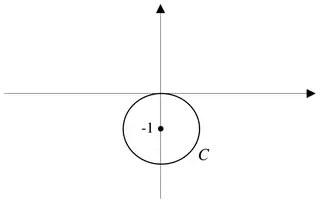 | B1 | 1.1b |
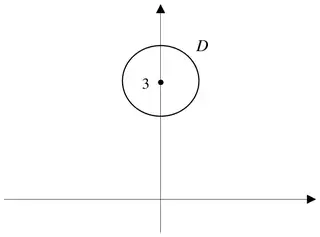 | B1ft | 1.1b |
| (2) | ||
| (6 marks) |
Notes
B1: The circle \(C\) correctly positioned, passing through the origin coordinates of centre labelled. Accept as coordinates or marked on axes.
B1ft: Their \(D\) correctly positioned with the centre correctly labelled (accept as coordinates or marked on axes).
Accept both drawn on the same diagram.
Allow S.C. B1B0 for two circles in correct respective positions but with no labelling.