
A2 June 2019 Q5
5.
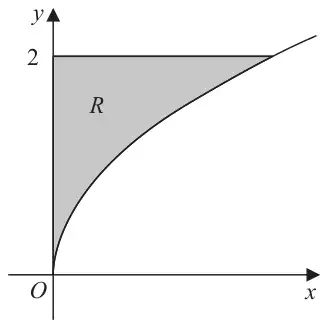
The region \(R\), shown shaded in Figure 4, is bounded by part of the curve with equation \(y^2 = 2x\), the line with equation \(y = 2\) and the \(y\)-axis. The unit of length on both axes is one centimetre. A uniform solid, \(S\), is formed by rotating \(R\) through 360° about the \(y\)-axis.
Given that the volume of \(S\) is \(\dfrac{8}{5}\pi\ \text{cm}^3\),
A uniform solid cylinder, \(C\), has base radius 2 cm and height 4 cm. The cylinder \(C\) is attached to \(S\) so that the plane face of \(S\) coincides with a plane face of \(C\), to form the paperweight \(P\), shown in Figure 5. The density of the material used to make \(S\) is three times the density of the material used to make \(C\).
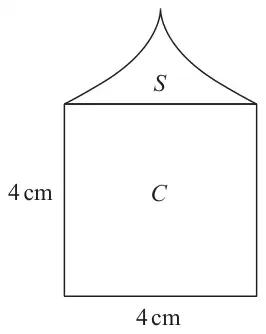
The plane face of \(P\) rests in equilibrium on a desk lid that is inclined at an angle \(\theta^\circ\) to the horizontal. The lid is sufficiently rough to prevent \(P\) from slipping. Given that \(P\) is on the point of toppling,
| Scheme | Marks | AO |
|---|---|---|
| \(\displaystyle\int \pi x^2 y\,\mathrm{d}y = \pi\int \frac{y^5}{4}\,\mathrm{d}y = \pi\left[\frac{y^6}{24}\right]_0^2\) | M1 | 3.4 |
| \(= \dfrac{64\pi}{24}\ \left(= \dfrac{8\pi}{3}\right)\) | A1 | 1.1b |
| \(\Rightarrow \bar{y} = \left(\text{their } \dfrac{8\pi}{3}\right)\times\dfrac{5}{8\pi}\ \left(= \dfrac{5}{3}\right)\) | M1 | 3.1a |
| Distance from plane face \(= 2 - \dfrac{5}{3} = \dfrac{1}{3}\) * | A1* | 2.2a |
| (4) |
Notes
M1: Use the model to find the moment about the base. Usual rules for integration. Correct limits
A1: Any equivalent form
M1: Use the model and volume to find \(\bar{y}\): their moments and \(\dfrac{8\pi}{5}\) used correctly
A1*: Obtain given answer from correct working
| Scheme | Marks | AO | ||||||||||||
|---|---|---|---|---|---|---|---|---|---|---|---|---|---|---|
| B1 | 1.2 | ||||||||||||
| Moments about diameter of the base: | M1 | 2.1 | ||||||||||||
| \(\dfrac{24}{5}\times\dfrac{13}{3} + 32 = \dfrac{104}{5}d\ \left(= \dfrac{264}{5}\right)\) | A1 | 1.1b | ||||||||||||
| \(d = \dfrac{264}{104}\ \left(= \dfrac{33}{13}\right)\) (cm) | A1 | 1.1b | ||||||||||||
| Complete strategy for \(\theta\) | M1 | 3.1a | ||||||||||||
| About to topple: \(\ \tan\theta = \dfrac{2}{d}\ \left(= \dfrac{26}{33}\right)\) | A1ft | 3.4 | ||||||||||||
| \(\theta = 38.2\) (or 38) | A1 | 2.2a | ||||||||||||
| (7) | ||||||||||||||
| (11 marks) |
Notes
B1: Correct mass ratios seen or implied
M1: Moments equation. Dimensionally correct. Allow for their mass ratios
A1: Correct unsimplified equation
A1: Any equivalent form (2.54 cm)
M1: Complete strategy to find the position of the centre of mass of the composite body and use trig. to find \(\theta\)
A1ft: Trig ratio for a relevant angle. Follow their \(d\)
A1: Correct angle (38 or better) (38.2338....)