
A2 October 2020 Q5
5.
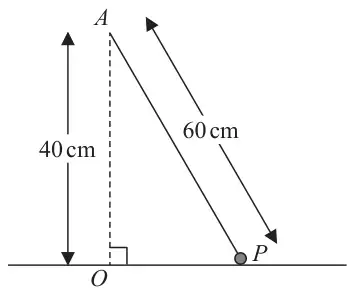
A particle \(P\) of mass 0.75 kg is attached to one end of a light inextensible string of length 60 cm. The other end of the string is attached to a fixed point \(A\) that is vertically above the point \(O\) on a smooth horizontal table, such that \(OA = 40\) cm. The particle remains in contact with the table, with the string taut, and moves in a horizontal circle with centre \(O\), as shown in Figure 4.
The particle is moving with a constant angular speed of 3 radians per second.
The angular speed of \(P\) is now gradually increased.
| Scheme | Marks | AO |
|---|---|---|
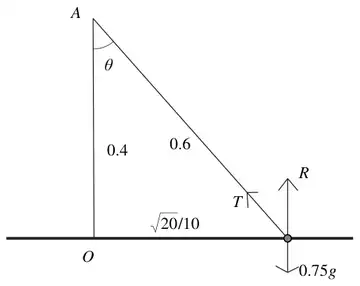 | ||
| Resolve vertically | M1 | 3.4 |
| \(\updownarrow 0.75g = T\cos\theta + R\) \(\left(\dfrac{3g}{4} = \dfrac{2}{3}T + R\right)\) | A1 | 1.1b |
| Equation of motion | M1 | 3.4 |
| \(\leftrightarrow 0.75\times 0.6\sin\theta\times 9 = T\sin\theta\) \(\left(0.75\times\dfrac{\sqrt{20}}{10}\times 9 = T\times\dfrac{\sqrt{20}}{6}\right)\) | A1 | 1.1b |
| Complete strategy to find \(T\) and \(R\) | M1 | 3.1a |
| \(T = \dfrac{6\times 0.75\times 9}{10} = 4.05\) (N) | A1 | 1.1b |
| \(R = 0.75g - \dfrac{2}{3}T = 4.65\) (N) or 4.7 (N) | A1 | 1.1b |
| (7) |
Notes
Second A1 line: corrected from the printed mark scheme: the printed line reads \(0.75\times\sin\theta\times 9 = T\sin\theta\), missing the radius \(0.6\sin\theta\) (the bracketed line and part (b) both use it).
M1: Correct number of terms
A1: Correct unsimplified equation
M1: Circular motion. Condone confusion over units. \(\dfrac{\sqrt{20}}{10}\) might not be seen as \(r\) cancels.
A1: Correct unsimplified equation
M1: Complete strategy to form sufficient equations to solve for \(T\) and \(R\).
A1: One force correct
A1: Both correct (Finding value for \(R\) involves \(g\))
| Scheme | Marks | AO |
|---|---|---|
| Use \(R = 0\) to form revised equations | M1 | 3.4 |
| \(T\cos\theta = 0.75g,\quad T\sin\theta = 0.75\times\dfrac{10\sqrt{20}}{100}\omega^2\) \(\big(\text{or } T\sin\theta = 0.75\times 0.6\sin\theta\times\omega^2\big)\) | A1 | 1.1b |
| Complete strategy to find \(\omega\) e.g. \(\Rightarrow \tan\theta = \dfrac{\sqrt{20}\omega^2}{10g} = \dfrac{\sqrt{20}}{4}\) | M1 | 1.1b |
| \(\omega = \sqrt{\dfrac{5g}{2}} = 4.95\) (rad/s) | A1 | 1.1b |
| (4) | ||
| (11 marks) |
Notes
M1: Correct interpretation of loss of contact
A1: Revised equations
M1: Solve for \(\omega\)
A1: Exact, 4.9 or 4.95 (non-exact answer requires substitution for \(g\)).