
A2 June 2022 Q5
5.
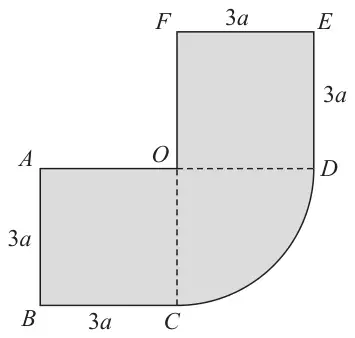
The uniform plane lamina shown in Figure 3 is formed from two squares, \(ABCO\) and \(ODEF\), and a sector \(ODC\) of a circle with centre \(O\). Both squares have sides of length \(3a\) and \(AO\) is perpendicular to \(OF\). The radius of the sector is \(3a\)
[In part (a) you may use, without proof, any of the centre of mass formulae given in the formulae booklet.]
The lamina is freely suspended from \(F\) and hangs in equilibrium with \(FC\) at an angle \(\theta^\circ\) to the downward vertical.
| Scheme | Marks | AO |
|---|---|---|
| Using sector: distance \(OG = \dfrac{2\times 3a\sin\frac{\pi}{4}}{3\times\frac{\pi}{4}}\) | B1 | 1.1b |
| Using Pythagoras: \(2d^2 = \dfrac{32a^2}{\pi^2} \quad \left(d^2 + d^2 = OG^2\right)\) Or using trigonometry: Distance from \(OC = OG\cos 45^\circ = OG\sin 45^\circ\) | M1 | 2.1 |
| \(d = \sqrt{\dfrac{16a^2}{\pi^2}} = \dfrac{4a}{\pi}\) * | A1* | 2.2a |
| (3) |
Notes
B1: Correct application of standard result from formula booklet.
Must substitute for \(\alpha\) but need not simplify
Implied if you see \(\left(= \dfrac{4\sqrt{2}a}{\pi}\right)\)
M1: Correct strategy to find the distance for the quadrant
Need to see use of \(\dfrac{1}{\sqrt{2}}\) or \(\dfrac{\sqrt{2}}{2}\) somewhere in the solution
A1*: Obtain the given result from correct working.
Alternative (a)
| Scheme | Marks | AO |
|---|---|---|
Using semicircle of radius \(3a\): \(\bar{y} = \dfrac{4\times 3a}{3\pi}\left(= \dfrac{4a}{\pi}\right)\)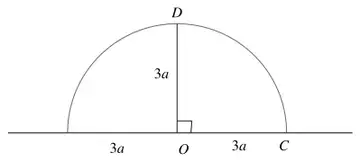 | B1 | 1.1b |
| Moments about diameter: \(\dfrac{9\pi a^2}{2}\times\dfrac{4a}{\pi} = 2\times\dfrac{9\pi a^2}{4}\times d\) | M1 | 2.1 |
| \(\Rightarrow d = \dfrac{4a}{\pi}\) * | A1* | 2.2a |
| (3) |
| Scheme | Marks | AO | ||||||||||||
|---|---|---|---|---|---|---|---|---|---|---|---|---|---|---|
| B1 | 1.2 | ||||||||||||
| Moments about \(FC\): | M1 | 3.1a | ||||||||||||
| \(-9\times\dfrac{3a}{2} + 9\times\dfrac{3a}{2} + \dfrac{9\pi}{4}\times\dfrac{4a}{\pi} = \left(18 + \dfrac{9\pi}{4}\right)\bar{x}\ (= 9a)\) | A1 | 1.1b | ||||||||||||
| \(\bar{x} = \dfrac{4a}{8 + \pi}\) | A1 | 1.1b | ||||||||||||
| (4) |
Notes
B1: Correct masses and distance from \(FC\) or a parallel axis or \(BOE\)
Seen or implied (a bright candidate might realise that if taking moments about \(FC\) then the two squares cancel each other).
M1: Moments about \(FC\) or a parallel axis or \(BOE\). All terms required, and dimensionally correct. Condone sign errors.
Accept as part of a vector equation.
A1: Correct unsimplified equation for their axis
A1: Or equivalent with no errors seen
Accept \(0.36a\) or better \((0.3590\ldots a)\)
Alternative (b)
| Scheme | Marks | AO | ||||||||||||
|---|---|---|---|---|---|---|---|---|---|---|---|---|---|---|
| B1 | 1.2 | ||||||||||||
| Moments about \(BOE\): | M1 | 3.1a | ||||||||||||
| \(\left(18 + \dfrac{9\pi}{4}\right)d = \dfrac{9\pi}{4}\times\dfrac{4\sqrt{2}a}{\pi}\) | A1 | 1.1b | ||||||||||||
| \(\bar{x} = d\cos 45^\circ = \dfrac{4a}{8 + \pi}\) | A1 | 1.1b | ||||||||||||
| (4) |
| Scheme | Marks | AO |
|---|---|---|
| \(\bar{y} = \dfrac{4a}{8 + \pi}\) from \(OD\) or \(\bar{y} = 3a + \dfrac{4a}{8 + \pi}\) from \(FE\) | B1ft | 1.1b |
| Complete method to find a relevant angle | M1 | 3.1a |
| \(\theta^\circ = \tan^{-1}\left(\dfrac{\bar{x}}{3a + \bar{y}}\right) = \tan^{-1}\left(\dfrac{4a}{28a + 3\pi a}\right)\) | A1ft | 1.1b |
| \(\theta = 6.1\) | A1 | 1.1b |
| (4) | ||
| (11 marks) |
Notes
B1ft: Allow use of symmetry seen or implied.
Accept \(\bar{y} = \bar{x}\)
(From FE, \(\bar{y} = \dfrac{28a + 3\pi a}{8 + \pi}\)) Accept + / -
M1: Correct strategy to find a relevant angle
(\(\theta\) or \(90 - \theta\)) Need to substitute their values of \(\bar{x}\) and distance from \(F \ne \dfrac{4a}{\pi}\).
A1ft: Correct unsimplified expression for a relevant angle. Follow their \(\bar{x}\) and \(\bar{y}\)
A1: 6.1 or better (6.10067…)
The question defines \(\theta\) as measured in degrees. 0.106 can score B1M1A1ftA0
Do not ISW