
A2 October 2020 Paper 1 Q11
11 In this question you must show detailed reasoning.
In Fig. 11, the points A, B, C, D, E and F represent the complex sixth roots of 64 on an Argand diagram. The midpoints of AB, BC, CD, DE, EF and FA are G, H, I, J, K and L respectively.
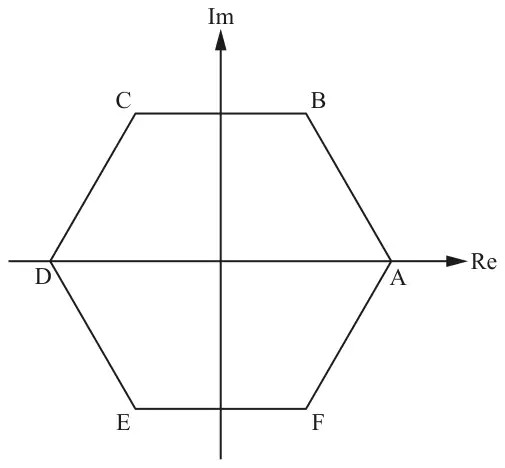
(a) Write down, in exponential \((r\mathrm{e}^{\mathrm{i}\theta})\) form, the complex numbers represented by the points A, B, C, D, E and F. [2]
(b) When these complex numbers are multiplied by the complex number \(w\), the resulting complex numbers are represented by the points G, H, I, J, K and L.
Find \(w\) in exponential form. [4]
Find \(w\) in exponential form. [4]
(c) You are given that G, H, I, J, K and L represent roots of the equation \(z^6 = p\).
Find \(p\). [2]
Find \(p\). [2]
| Scheme | Marks | AO |
|---|---|---|
| DR \(2,\ 2\mathrm{e}^{\mathrm{i}\pi/3},\ 2\mathrm{e}^{2\mathrm{i}\pi/3},\ -2,\ 2\mathrm{e}^{4\mathrm{i}\pi/3},\ 2\mathrm{e}^{5\mathrm{i}\pi/3}\) | M1 A1 | 2.5 2.5 |
| [2] |
Notes
M1: modulus 2
| Scheme | Marks | AO |
|---|---|---|
| DR modulus of G \(= \sqrt{3}\) modulus of \(w\) \(= \frac{\sqrt{3}}{2}\) argument \(= \pi/6\) | B1 B1 B1 | 3.1a 1.1 1.1 |
| So \(w = \dfrac{\sqrt{3}}{2}\mathrm{e}^{\frac{\mathrm{i}\pi}{6}}\) | B1 | 1.1 |
| [4] |
| Scheme | Marks | AO |
|---|---|---|
| DR \(\left(\sqrt{3}\mathrm{e}^{\frac{\mathrm{i}\pi}{6}}\right)^6 = 27\mathrm{e}^{\mathrm{i}\pi} = -27\) | M1 | 1.1 |
| so \(p = -27\) | A1 | 1.1 |
| [2] |
Notes
M1: taking the \(6^{\text{th}}\) power of one of the midpoints