
A2 October 2020 Paper 1 Q5
5 Fig. 5 shows the curve with polar equation \(r = a(3 + 2\cos\theta)\) for \(-\pi \leqslant \theta \leqslant \pi\), where \(a\) is a constant.
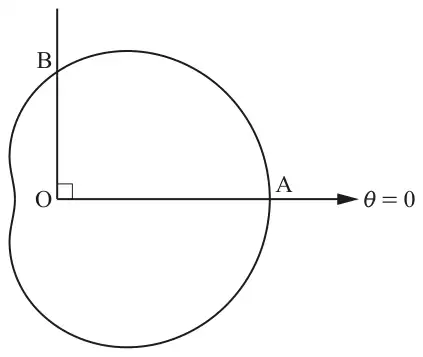
(a) Write down the polar coordinates of the points A and B. [2]
(b) Explain why the curve is symmetrical about the initial line. [2]
(c) In this question you must show detailed reasoning.
Find in terms of \(a\) the exact area of the region enclosed by the curve. [4]
Find in terms of \(a\) the exact area of the region enclosed by the curve. [4]
| Scheme | Marks | AO |
|---|---|---|
| A is \([5a, 0]\), B is \([3a, \frac{1}{2}\pi]\) | B1 B1 | 1.1 1.1 |
| [2] |
Notes
SC: Coordinates reversed \((\theta, r)\) award B1B0
| Scheme | Marks | AO |
|---|---|---|
| \(\cos(-\theta) = \cos\theta\) so the value of \(r\) for \(-\theta\) is the same as for \(\theta\) | M1 A1 | 2.4 2.2a |
| [2] |
Notes
M1: accept even function
| Scheme | Marks | AO |
|---|---|---|
| DR \(A = \dfrac{1}{2}a^2\displaystyle\int_{-\pi}^{\pi} (3 + 2\cos\theta)^2\,\mathrm{d}\theta\) | B1 | 1.1 |
| \(= \dfrac{1}{2}a^2\displaystyle\int_{-\pi}^{\pi} (9 + 12\cos\theta + 4\cos^2\theta)\,\mathrm{d}\theta\) | M1 | 3.1a |
| \(= \dfrac{1}{2}a^2\displaystyle\int_{-\pi}^{\pi} (11 + 12\cos\theta + 2\cos 2\theta)\,\mathrm{d}\theta\) | ||
| \(= \dfrac{1}{2}a^2\left[11\theta + 12\sin\theta + \sin 2\theta\right]_{-\pi}^{\pi}\) | A1 | 1.1 |
| \(= 11\pi a^2\) | A1cao | 1.1 |
| [4] |
Notes
B1: or \(a^2\displaystyle\int_0^{\pi} (3 + 2\cos\theta)^2\,\mathrm{d}\theta\); limits seen in work
M1: substitute an expression involving \(\cos 2\theta\) for \(\cos^2\theta\)
A1: \(= \left[11\theta + 12\sin\theta + \sin 2\theta\right]\)