
A2 June 2022 Paper 1 Q15
15 In an oscillating system, a particle of mass \(m\) kg moves in a horizontal line. Its displacement from its equilibrium position O at time \(t\) seconds is \(x\) metres, its velocity is \(v\) m s−1, and it is acted on by a force \(2mx\) newtons acting towards O as shown in the diagram.
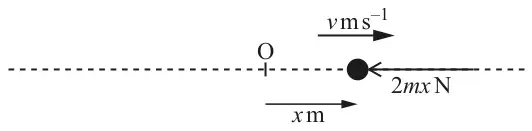
Initially, the particle is projected away from O with speed 1 m s−1 from a point 2 m from O in the positive direction.
\(\dfrac{\mathrm{d}^2x}{\mathrm{d}t^2} + 2\dfrac{\mathrm{d}x}{\mathrm{d}t} + 2x = 2\cos 2t\).
In the long term, the particle is seen to perform simple harmonic motion with a period of just over 3 seconds.
| Scheme | Marks | AO |
|---|---|---|
| (i) \(m\dfrac{d^2x}{dt^2} = -2mx \Rightarrow \dfrac{d^2x}{dt^2} + 2x = 0\) | B1 | 3.1b |
| [1] |
Notes
B1: AG
| Scheme | Marks | AO |
|---|---|---|
| (ii) Simple harmonic motion | B1 | 3.3 |
| [1] |
| Scheme | Marks | AO |
|---|---|---|
| (iii) \(\frac{2\pi}{\sqrt{2}} = \sqrt{2}\pi\) (s) | B1 | 1.2 |
| [1] |
Notes
B1: Accept anything wrt 4.4
| Scheme | Marks | AO |
|---|---|---|
| (iv) General solution: \(x = A\cos\sqrt{2}t + B\sin\sqrt{2}t\) | B1 | 1.1 |
| \(t = 0,\ x = 2 \Rightarrow A = 2\) | B1 | 3.3 |
| \(\dfrac{\mathrm{d}x}{\mathrm{d}t} = -\sqrt{2}A\sin\sqrt{2}t + \sqrt{2}B\cos\sqrt{2}t\) \(t = 0,\ \dfrac{\mathrm{d}x}{\mathrm{d}t} = 1 \Rightarrow B = \dfrac{1}{\sqrt{2}} = \dfrac{\sqrt{2}}{2}\) | M1 | 1.1 |
| so \(x = 2\cos\sqrt{2}t + \frac{\sqrt{2}}{2}\sin\sqrt{2}t\) | A1 | 3.3 |
| [4] |
Notes
B1: Must come from correct GS
M1: Must be differentiating a function in terms of cos and sin
| Scheme | Marks | AO |
|---|---|---|
| (v) Amplitude \(= \sqrt{2^2 + \left(\dfrac{1}{2}\sqrt{2}\right)^2}\) | M1 | 3.4 |
| \(= \frac{3\sqrt{2}}{2}\) (m) | A1 | 1.1 |
| [2] |
Notes
A1: Accept anything wrt 2.1
| Scheme | Marks | AO |
|---|---|---|
| (i) \(m\frac{\mathrm{d}^2x}{\mathrm{d}t^2} = -2mx - 2m\frac{\mathrm{d}x}{\mathrm{d}t}\) \(\Rightarrow \dfrac{\mathrm{d}^2x}{\mathrm{d}t^2} + 2\dfrac{\mathrm{d}x}{\mathrm{d}t} + 2x = 0\) | B1 | 3.1b |
| [1] |
Notes
B1: AG
| Scheme | Marks | AO |
|---|---|---|
| (ii) Underdamped as \(2^2 - 4 \times 1 \times 2 \lt 0\) | B1 | 3.5b |
| [1] |
Notes
B1: Stating complex roots of auxillary equation is acceptable \((-1 \pm i)\)
| Scheme | Marks | AO |
|---|---|---|
| (iii) Auxiliary equation: \(\lambda^2 + 2\lambda + 2 = 0\) | M1 | 1.2 |
| \(\lambda = \dfrac{-2 \pm \sqrt{-4}}{2} = -1 \pm i\) | A1 | 1.1 |
| General solution: \(x = e^{-t}(A\cos t + B\sin t)\) | A1 | 1.1 |
| [3] |
Notes
A1: soi
| Scheme | Marks | AO |
|---|---|---|
| (i) Particular integral: \(x = C\cos 2t + D\sin 2t\) \(-4C + 4D + 2C = 2,\ -4D - 4C + 2D = 0\) \(\Rightarrow C = -0.2,\ D = 0.4\) | M1 M1 A1 | 2.1 3.3 2.2a |
| \(x = e^{-t}(A\cos t + B\sin t) - 0.2\cos 2t + 0.4\sin 2t\) \(t = 0,\ x = 2 \Rightarrow A = 2.2\) | B1 | 3.3 |
| \(\dfrac{\mathrm{d}x}{\mathrm{d}t} = -e^{-t}(A\cos t + B\sin t) + e^{-t}(-A\sin t + B\cos t)\) \(+0.4\sin 2t + 0.8\cos 2t\) | M1* | 2.1 |
| \(t = 0,\ \dfrac{\mathrm{d}x}{\mathrm{d}t} = 1 \Rightarrow 1 = -A + B + 0.8\) \(\Rightarrow B = 2.4\) | M1dep* | 3.3 |
| \(x = \mathrm{e}^{-t}(2.2\cos t + 2.4\sin t) - 0.2\cos 2t + 0.4\sin 2t\) | A1cao | 2.2a |
| [7] |
Notes
B1: Has to come from a correct CF
M1*: Must include use of product rule from x = CF + PI
M1dep*: For substitution to lead to an equation in A and B
| Scheme | Marks | AO |
|---|---|---|
| (ii) As \(t \to \infty,\ x \to -0.2\cos 2t + 0.4\sin 2t\) [this is SHM] with period \(\frac{2\pi}{2} = \pi \approx 3.14\) \(s\) | M1 A1 | 3.5a 3.5a |
| [2] |
Notes
M1: Dependent on a function containing \(e^{-kt}\) and \(\cos pt\) and \(\sin pt\)