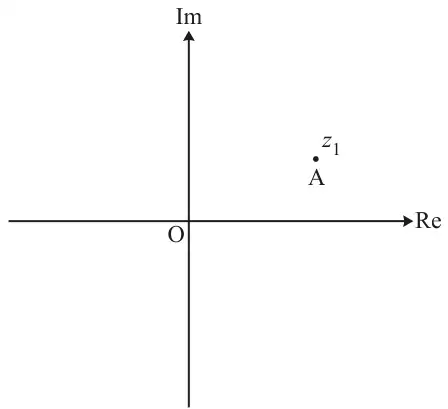
11 An Argand diagram with the point A representing a complex number \(z_1\) is shown below.
The complex numbers \(z_2\) and \(z_3\) are \(z_1\mathrm{e}^{\frac{2}{3}\mathrm{i}\pi}\) and \(z_1\mathrm{e}^{\frac{4}{3}\mathrm{i}\pi}\) respectively.
(a)
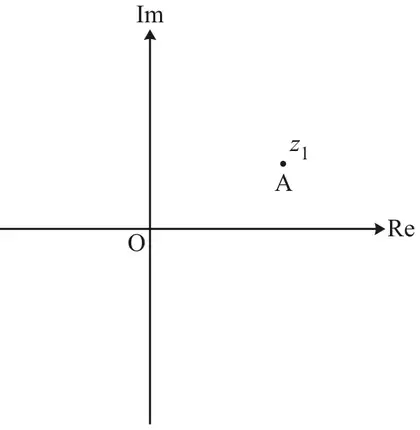
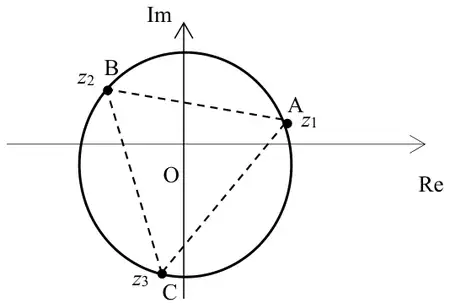
(i) On the copy of the Argand diagram below, mark the points B and C representing the complex numbers \(z_2\) and \(z_3\). [2]
(ii) Show that \(z_1 + z_2 + z_3 = 0\). [2]
(b) Given now that \(z_1\), \(z_2\) and \(z_3\) are roots of the equation \(z^3 = 8\mathrm{i}\), find these three roots, giving your answers in the form \(a + \mathrm{i}b\), where \(a\) and \(b\) are real and exact. [4]
Mark scheme (a)
Scheme
Marks
AO
(i)
M1
A1
1.1
1.1
[2]
Notes
M1: on a circle centre O
A1: form an approximate equilateral triangle B and C must be labelled