
A2 June 2022 Paper 1 Q3
3 In this question you must show detailed reasoning.
The loci \(\mathrm{C}_1\) and \(\mathrm{C}_2\) are given by \(|z| = |z - 2\mathrm{i}|\) and \(|z - 2| = \sqrt{5}\) respectively.
\(\{z : |z| \leqslant |z - 2\mathrm{i}|\} \cap \{z : |z - 2| \leqslant \sqrt{5}\}\). [1]
| Scheme | Marks | AO |
|---|---|---|
| DR \(z = \dfrac{2 \pm \sqrt{-36}}{4} \Rightarrow z = \dfrac{1}{2} \pm \dfrac{3}{2}\mathrm{i}\) or \(2\left(z^2 - z\right) = -5 \Rightarrow 2\left(z^2 - z + \dfrac{1}{4}\right) = -\dfrac{9}{2}\) \(\left(z - \dfrac{1}{2}\right)^2 = -\dfrac{9}{4} \Rightarrow z - \dfrac{1}{2} = \pm\dfrac{3}{2}\mathrm{i} \Rightarrow z = \dfrac{1}{2} \pm \dfrac{3}{2}\mathrm{i}\) | M1 A1 | 1.1 1.1 |
| [2] |
Notes
M1: Using correct quadratic formula with correct substitutions
Or completing the square (Root of negative number must be seen)
A1: Final answer
| Scheme | Marks | AO |
|---|---|---|
 | B1 B1 B1 | 1.1 1.1 2.2a |
| [3] |
Notes
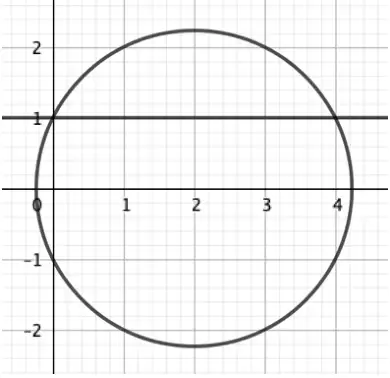
(i) B1: Correct line \(\operatorname{Im}(z) = 1\)
B1: Circle centre 2
B1: Circle intersect on imaginary axis at \(\pm\mathrm{i}\)
| Scheme | Marks | AO |
|---|---|---|
| (ii) Major segment (area below line and inside circle) shaded. | B1 | 1.1 |
| [1] |
Notes
(ii) B1: ft their circle and their horizontal line from (ii)
| Scheme | Marks | AO |
|---|---|---|
| (i) DR \(|z - 2| = \left|-\dfrac{3}{2} \pm \dfrac{3}{2}\mathrm{i}\right| = \sqrt{\left(-\dfrac{3}{2}\right)^2 + \left(\pm\dfrac{3}{2}\right)^2}\) | M1 | 2.1 |
| \(= \sqrt{\dfrac{9}{2}} \lt \left(\sqrt{\dfrac{10}{2}}\right) = \sqrt{5}\) | A1 | 2.2a |
| [2] |
Notes
M1: ft For calculating modulus of their \(|z - 2|\) for at least one of their values of \(z\).
A1: AG. Must see clear statement of inequality (eg as shown or by values). Both roots
If shown that \(|z - 2|^2 \lt 5\), must explain that \(|z - 2| \lt \sqrt{5}\) follows from \(|z - 2| \geqslant 0\).
| Scheme | Marks | AO |
|---|---|---|
| (ii) \(\dfrac{1}{2} - \dfrac{3}{2}\mathrm{i}\) because \(\operatorname{Im}\left(\dfrac{1}{2} - \dfrac{3}{2}\mathrm{i}\right) = -\dfrac{3}{2} \lt 1\) | B1 | 2.2a |
| [1] |
Notes
(ii) B1: Or \(\left|\dfrac{1}{2} - \dfrac{3}{2}\mathrm{i}\right| = \sqrt{\dfrac{5}{2}} \lt \left|\dfrac{1}{2} - \dfrac{3}{2}\mathrm{i} - 2\mathrm{i}\right| = \dfrac{5\sqrt{2}}{2}\) ft their roots as long as their roots are conjugate pairs with imaginary part of magnitude greater than one.
Could be explained in terms of loci (ie “because (the point representing) \(\frac{1}{2} - \frac{3}{2}\mathrm{i}\) is closer to \(O\) than it is to (the point representing) \(2\mathrm{i}\)”) but must be consistent with their diagram after (d).
Or “below the perpendicular bisector” or “below axis”
isw after acceptable answer
| Scheme | Marks | AO |
|---|---|---|
 | M1 A1 | 3.1a 1.1 |
| [2] |
Notes
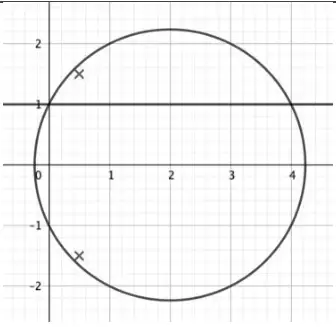
M1: For a complex conjugate pair.
A1: Approximate positions inside their circle above and below the line