
A2 June 2023 Q7
7.
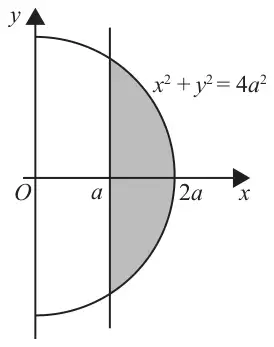
The shaded region shown in Figure 5 is bounded by the line with equation \(x = a\) and the curve with equation \(x^2 + y^2 = 4a^2\)
This shaded region is rotated through \(180^\circ\) about the \(x\)-axis to form a solid of revolution.
This solid is used to model a dome with height \(a\) metres and base radius \(\sqrt{3}a\) metres.
The dome is modelled as being non-uniform with the mass per unit volume of the dome at the point \((x, y, z)\) equal to \(\dfrac{\lambda}{x^2}\ \text{kg m}^{-3}\), where \(a \leqslant x \leqslant 2a\) and \(\lambda\) is a constant.
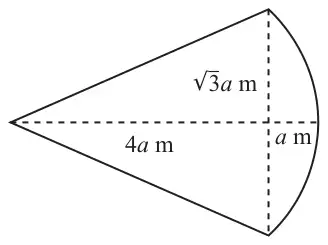
A solid uniform right circular cone has base radius \(\sqrt{3}a\) metres and perpendicular height \(4a\) metres. A toy is formed by attaching the plane surface of the dome to the plane surface of the cone, as shown in Figure 6.
The weight of the cone is \(kW\) and the weight of the dome is \(2W\)
The centre of mass of the toy is a distance \(d\) metres from the plane face of the dome.
The toy is suspended from a point on the circumference of the plane face of the dome and hangs freely in equilibrium with the plane face of the dome at an angle \(\alpha\) to the downward vertical.
Given that \(\tan\alpha = \dfrac{1}{2\sqrt{3}}\)
| Scheme | Marks | AO |
|---|---|---|
| Mass of dome \(= \displaystyle\int_a^{2a} \pi y^2\dfrac{\lambda}{x^2}\,\mathrm{d}x = \pi\lambda\int_a^{2a} \dfrac{4a^2 - x^2}{x^2}\,\mathrm{d}x = \pi\lambda\int_a^{2a} \left(\dfrac{4a^2}{x^2} - 1\right)\mathrm{d}x\) | M1 | 3.4 |
| \(= \pi\lambda\left[\dfrac{-4a^2}{x} - x\right]_a^{2a} \quad \left(= \pi\lambda\left[\dfrac{-4a^2}{2a} - 2a + \dfrac{4a^2}{a} + a\right] = \pi\lambda a\ \text{(kg)}\right)\) | A1 | 1.1b |
| Moments: \(\displaystyle\int_a^{2a} \pi y^2\dfrac{\lambda}{x^2} \times x\,\mathrm{d}x = \pi\lambda\int_a^{2a} \left(\dfrac{4a^2}{x} - x\right)\mathrm{d}x\) | M1 | 3.4 |
| \(= \pi\lambda\left[4a^2\ln x - \dfrac{1}{2}x^2\right]_a^{2a} \quad \left(= \pi\lambda\left(4a^2\ln 2 - \dfrac{3a^2}{2}\right)\right)\) | A1 | 1.1b |
| \(\Rightarrow \text{distance} = \dfrac{\pi\lambda\left(4a^2\ln 2 - \dfrac{3a^2}{2}\right)}{\pi\lambda a}\) | DM1 | 2.1 |
| \(\Rightarrow \text{distance} = 4a\ln 2 - \dfrac{3a}{2} - a = \left(4\ln 2 - \dfrac{5}{2}\right)a\ \text{(m)}\) * | A1* | 2.2a |
| (6) |
Notes
M1: Use the model to find the mass of the dome. Allow without limits.
A1: Correct integration. Correct limits seen or implied.
M1: Use the model to take moments (usual rules for integration).
Allow without limits.
A1: Correct integration. Correct limits seen or implied.
DM1: Complete method to find the distance of the centre of mass from the centre of the plane face.
A1*: Obtain the given answer from full and correct working.
| Scheme | Marks | AO |
|---|---|---|
| Centre of mass of cone lies \(a\) m from the plane surface | B1 | 1.1b |
| Moments about a diameter of the plane face | M1 | 3.1b |
| \(a \times kW - a\left(4\ln 2 - \dfrac{5}{2}\right) \times 2W = (2 + k)Wd\) | A1 | 1.1b |
| \(d = \dfrac{|k + 5 - 8\ln 2|}{2 + k}a\) * | A1* | 2.2a |
| (4) |
Notes
B1: Seen or implied
M1: Moments equation. Need all terms. Dimensionally correct. Allow use of a parallel axis.
A1: Correct unsimplified equation in \(d\)
A1*: Obtain given answer from correct working.
Condone if modulus signs not used
| Scheme | Marks | AO |
|---|---|---|
| Use of trigonometry | M1 | 3.1b |
| \(\tan\alpha = \dfrac{\left(\dfrac{k + 5 - 8\ln 2}{2 + k}\right)a}{\sqrt{3}a} \quad \left(= \dfrac{1}{2\sqrt{3}}\right)\) | A1 | 1.1b |
| \(\Rightarrow k = 16\ln 2 - 8\) | A1 | 1.1b |
| (3) | ||
| (13 marks) |
Notes
M1: Complete method to find the required angle, e.g. by use of tangent.
Condone if they ignore the modulus signs.
A1: Correct unsimplified equation.
A1: Any equivalent exact form.