
A2 June 2025 Q8
8.
In this question use \(g = 10\ \text{m s}^{-2}\)
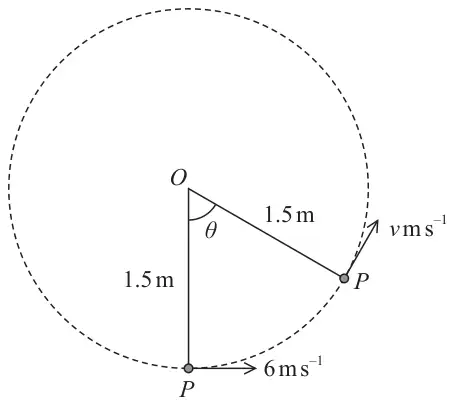
A particle \(P\) of mass 0.4 kg is attached to one end of a light inextensible string of length 1.5 m. The other end of the string is attached to a fixed point \(O\). The particle is at rest vertically below \(O\) with the string taut.
The particle is then projected horizontally with speed \(6\ \text{m s}^{-1}\)
When the string has turned through an angle \(\theta\), the string is still taut and the speed of \(P\) is \(v\ \text{m s}^{-1}\), as shown in Figure 8.
| Scheme | Marks | AO |
|---|---|---|
| Conservation of energy: | M1 | 3.1a |
| \(\dfrac{1}{2}mu^2 = \dfrac{1}{2}mv^2 + mg \times r(1 - \cos\theta)\) | A1 A1 | 1.1b 1.1b |
| Equation of motion | M1 | 3.1a |
| \(T - mg\cos\theta = \dfrac{mv^2}{r}\) | A1 | 1.1b |
| Complete strategy to find \(T\) | M1 | 2.1 |
| \(T = \dfrac{4 \times 18}{15} + 1.6 = 6.4\ \text{(N)}\) * | A1* | 2.2a |
| (7) |
Notes
SC: Candidates who use \(g = 9.8\) are eligible for all marks except the final A1 in each of parts (a) and (b).
If they only use \(g = 9.8\) in one part, then this penalty only applies to that part.
In part (b) candidates are also eligible for all marks except the final A1 if they use the given answer of 6.4 from (a) along with \(g = 9.8\) in their other work.
M1: Need all terms. Dimensionally correct. Condone sign errors and sin/cos confusion
A1: Unsimplified equation with at most one error
A1: Correct unsimplified equation. Accept with \(g\) or 10
M1: Need all terms. Dimensionally correct. Condone sign errors and sin/cos confusion
A1: Correct unsimplified equation. Accept with \(g\) or 10
M1: Complete strategy to find \(T\) e.g. use conservation of energy, circular motion and substitute value for \(v\) to form sufficient equations to find \(T\)
A1*: Obtain given answer from correct working.
N.B. \(g = 9.8\) gives \(T = 6.32\) (but scores A0)
| Scheme | Marks | AO |
|---|---|---|
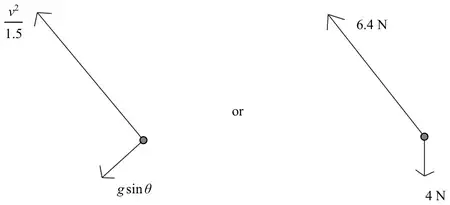
| \(\cos\theta = 0.4\) | B1 | 1.1b |
 | B1 B1 | 1.1b 1.1b |
| Use of Pythagoras or cosine rule and \(F = ma\) | M1 | 3.1a |
| \(|a| = \sqrt{12^2 + 100 \times \dfrac{21}{25}} = 2\sqrt{57} = 15\ \left(\text{m s}^{-2}\right)\) | A1 | 1.1b |
| (5) | ||
| (12 marks) |
Notes
SC: Candidates who use \(g = 9.8\) are eligible for all marks except the final A1 in each of parts (a) and (b).
If they only use \(g = 9.8\) in one part, then this penalty only applies to that part.
In part (b) candidates are also eligible for all marks except the final A1 if they use the given answer of 6.4 from (a) along with \(g = 9.8\) in their other work.
B1: Correct only. Must be seen or used in part (b). Award for \(\sin\theta = \dfrac{\sqrt{21}}{5}\)
N.B. \(g = 9.8\) gives \(\cos\theta = \dfrac{19}{49}\ (= 0.38775...)\), \(\sin\theta = \dfrac{2\sqrt{510}}{49}\ (= 0.92176...)\)
B1: One component of acceleration or force correct (unsimplified)
B1: Both components of acceleration or force correct (unsimplified)
N.B. \(g = 9.8\) gives components as 12 & 9.03 (velocity) or 6.32 and 3.92 (force)
M1: Complete strategy to find magnitude of acceleration.
\(|F| = \sqrt{6.4^2 + 4^2 - 2 \times 6.4 \times 4 \times \cos\theta} = 0.4a\)
A1: Accept 15 or better (15.09966887…) including exact equivalent
N.B. \(g = 9.8\) gives 15.01998… but scores A0
\(g = 9.8\) and \(T = 6.4\) gives 15.18025… but scores A0