
A2 June 2019 Paper 1 Q15
15 The diagram shows part of a spiral curve.
The point \(P\) has polar coordinates \((r, \theta)\) where \(0 \leqslant \theta \leqslant \dfrac{\pi}{2}\)
The points \(T\) and \(S\) lie on the initial line and \(O\) is the pole.
\(TPQ\) is the tangent to the curve at \(P\).
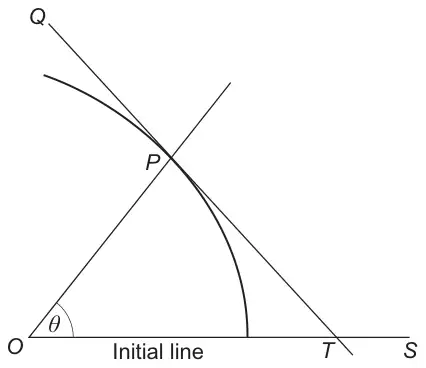
(a) Show that the gradient of \(TPQ\) is equal to\[\frac{\dfrac{\mathrm{d}r}{\mathrm{d}\theta}\sin\theta + r\cos\theta}{\dfrac{\mathrm{d}r}{\mathrm{d}\theta}\cos\theta - r\sin\theta}\] [4 marks]
(b) The curve has polar equation\[r = \mathrm{e}^{(\cot b)\theta}\]
where \(b\) is a constant such that \(0 \lt b \lt \dfrac{\pi}{2}\)
Use the result of part (a) to show that the angle between the line \(OP\) and the tangent \(TPQ\) does not depend on \(\theta\). [7 marks]
| Scheme | Marks | AO |
|---|---|---|
| Correctly converts polar to Cartesian coordinates (PI) | B1 | 3.1a |
| Finds correct expression for at least one of \(\dfrac{\mathrm{d}y}{\mathrm{d}\theta}\) and \(\dfrac{\mathrm{d}x}{\mathrm{d}\theta}\) | M1 | 1.1a |
| Divides their \(\dfrac{\mathrm{d}y}{\mathrm{d}\theta}\) by \(\dfrac{\mathrm{d}x}{\mathrm{d}\theta}\) | M1 | 1.1a |
| Completes proof, including statement that gradient \(= \dfrac{\mathrm{d}y}{\mathrm{d}x}\) | R1 | 2.1 |
Typical solution
\(x = r\cos\theta\) and \(y = r\sin\theta\)
\[\frac{\mathrm{d}y}{\mathrm{d}\theta} = \frac{\mathrm{d}r}{\mathrm{d}\theta}\sin\theta + r\cos\theta\]\[\frac{\mathrm{d}x}{\mathrm{d}\theta} = \frac{\mathrm{d}r}{\mathrm{d}\theta}\cos\theta - r\sin\theta\]\[\text{Gradient } = \frac{\mathrm{d}y}{\mathrm{d}x} = \frac{\dfrac{\mathrm{d}r}{\mathrm{d}\theta}\sin\theta + r\cos\theta}{\dfrac{\mathrm{d}r}{\mathrm{d}\theta}\cos\theta - r\sin\theta}\]| Scheme | Marks | AO |
|---|---|---|
| Differentiates \(r\) correctly using standard result. | B1 | 1.2 |
| Substitutes \(r\) and their \(\dfrac{\mathrm{d}r}{\mathrm{d}\theta}\) into expression for gradient from (a) | M1 | 3.1a |
| Rearranges into a form that can be recognised as a compound angle formula. | M1 | 1.1a |
| Deduces that gradient of \(TPQ\) is equal to \(\tan(\theta + b)\) | M1 | 2.2a |
| Deduces that angle \(STP = \theta + b\) Condone \(-(\theta + b)\) | M1 | 2.2a |
| Uses a geometric argument to explain why \(OPT\) is independent of \(\theta\) | M1 | 2.4 |
| Completes a rigorous argument to show the required result. | R1 | 2.1 |
| (11 marks) |
Typical solution
\[\frac{\mathrm{d}r}{\mathrm{d}\theta} = (\cot b)\mathrm{e}^{(\cot b)\theta}\]\[\frac{\mathrm{d}y}{\mathrm{d}x} = \frac{(\cot b)\mathrm{e}^{(\cot b)\theta}\sin\theta + \mathrm{e}^{(\cot b)\theta}\cos\theta}{(\cot b)\mathrm{e}^{(\cot b)\theta}\cos\theta - \mathrm{e}^{(\cot b)\theta}\sin\theta}\]\[= \frac{\cot b\sin\theta + \cos\theta}{\cot b\cos\theta - \sin\theta}\]\[= \frac{\dfrac{\cos b}{\sin b}\sin\theta + \cos\theta}{\dfrac{\cos b}{\sin b}\cos\theta - \sin\theta}\]\[= \frac{\cos b\sin\theta + \sin b\cos\theta}{\cos b\cos\theta - \sin b\sin\theta}\]\[= \frac{\sin(\theta + b)}{\cos(\theta + b)} = \tan(\theta + b)\]\(\therefore\) angle \(STP = \theta + b\)
\(\therefore\) angle \(OPT = b\) (exterior angle of a triangle)
So the angle between the line \(OP\) and the tangent \(TPQ\) does not depend on \(\theta\).