
A2 June 2023 Paper 1 Q9
9 In this question you must show detailed reasoning.
The function f is defined by
\[\mathrm{f}(x) = \sin\left(4\sin^{-1}\left(x^{\frac{1}{5}}\right)\right) - 8\sin\left(2\sin^{-1}\left(x^{\frac{1}{5}}\right)\right) + 12\sin^{-1}\left(x^{\frac{1}{5}}\right), \qquad x \in \mathbb{R},\ 0 \leqslant x \lt 1.\]
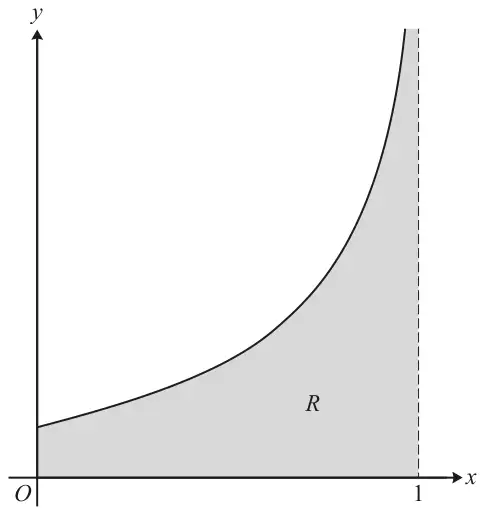
The diagram shows the curve with equation \(y = \dfrac{1}{\sqrt{1 - x^{\frac{2}{5}}}}\) for \(0 \leqslant x \lt 1\) and the asymptote \(x = 1\). The region \(R\) is the unbounded region between the curve, the \(x\)-axis, the line \(x = 0\) and the line \(x = 1\).
You are given that the area of \(R\) is finite.
| Scheme | Marks |
|---|---|
| DR \(\mathrm{e}^{\mathrm{i}\theta} - \mathrm{e}^{-\mathrm{i}\theta} = 2\mathrm{i}\sin\theta\) | B1 |
| \(\Rightarrow \left(\mathrm{e}^{\mathrm{i}\theta} - \mathrm{e}^{-\mathrm{i}\theta}\right)^4 = 16\sin^4\theta\) | M1 |
| \(\Rightarrow \left(\mathrm{e}^{4\mathrm{i}\theta} - 4\mathrm{e}^{2\mathrm{i}\theta} + 6 - 4\mathrm{e}^{-2\mathrm{i}\theta} + \mathrm{e}^{-4\mathrm{i}\theta}\right)\) | M1 |
| \(\Rightarrow \left(\mathrm{e}^{4\mathrm{i}\theta} - 4\mathrm{e}^{2\mathrm{i}\theta} + 6 - 4\mathrm{e}^{-2\mathrm{i}\theta} + \mathrm{e}^{-4\mathrm{i}\theta}\right) = \left(\mathrm{e}^{4\mathrm{i}\theta} + \mathrm{e}^{-4\mathrm{i}\theta}\right) - 4\left(\mathrm{e}^{2\mathrm{i}\theta} + \mathrm{e}^{-2\mathrm{i}\theta}\right) + 6\) \(\Rightarrow 2\cos 4\theta - 8\cos 2\theta + 6 = 16\sin^4\theta\) | M1 |
| \(\Rightarrow \sin^4\theta = \dfrac{1}{8}\cos 4\theta - \dfrac{1}{2}\cos 2\theta + \dfrac{3}{8}\) i.e. \(A = \dfrac{1}{8}, B = -\dfrac{1}{2}, C = \dfrac{3}{8}\) | A1 |
| [5] |
Notes
B1: Or \(\mathrm{e}^{\mathrm{i}\theta} + \mathrm{e}^{-\mathrm{i}\theta} = 2\cos\theta\) May use \(z\) without definition
M1: oe, eg. \((2\mathrm{i}\sin\theta)^4 = 16\sin^4\theta = \left(\mathrm{e}^{\mathrm{i}\theta} - \mathrm{e}^{-\mathrm{i}\theta}\right)^4\). Award this mark for \(\sin\theta\) to the power of four, and for \((2\mathrm{i})^4 = 16\). Note that 16 may appear later.
M1: Expanding \(\left(\mathrm{e}^{\mathrm{i}\theta} - \mathrm{e}^{-\mathrm{i}\theta}\right)^4\) with correct coefficients.
M1: Grouping terms and using \(\mathrm{e}^{\mathrm{i}\theta} + \mathrm{e}^{-\mathrm{i}\theta} = 2\cos\theta\).
A1: cao, from fully correct reasoning.
Allow \(A\), \(B\), \(C\) seen in the expression only.
| Scheme | Marks |
|---|---|
| DR Let \(u = x^{\frac{1}{5}} \Rightarrow \dfrac{\mathrm{d}u}{\mathrm{d}x} = \dfrac{1}{5}x^{-\frac{4}{5}}\) Let \(v = \sin^{-1}u \Rightarrow \dfrac{\mathrm{d}v}{\mathrm{d}u} = \dfrac{1}{\sqrt{1 - u^2}} = \dfrac{1}{\sqrt{1 - x^{\frac{2}{5}}}}\) | B1 |
| \(\Rightarrow \mathrm{f} = \sin 4v - 8\sin 2v + 12v \Rightarrow \dfrac{\mathrm{df}}{\mathrm{d}v} = 4\cos 4v - 16\cos 2v + 12\) | M1 |
| \(\dfrac{\mathrm{df}}{\mathrm{d}x} = \dfrac{\mathrm{df}}{\mathrm{d}v} \cdot \dfrac{\mathrm{d}v}{\mathrm{d}u} \cdot \dfrac{\mathrm{d}u}{\mathrm{d}x} = (4\cos 4v - 16\cos 2v + 12)\dfrac{1}{\sqrt{1 - x^{\frac{2}{5}}}} \times \dfrac{1}{5}x^{-\frac{4}{5}}\) | A1 |
| \(\dfrac{\mathrm{df}}{\mathrm{d}v} = 32\left(\dfrac{1}{8}\cos 4v - \dfrac{1}{2}\cos 2v + \dfrac{3}{8}\right) = 32(\sin v)^4 = 32u^4 = 32x^{\frac{4}{5}}\) | M1 M1 |
| Then \(\dfrac{\mathrm{df}}{\mathrm{d}x} = \dfrac{\mathrm{df}}{\mathrm{d}v} \cdot \dfrac{\mathrm{d}v}{\mathrm{d}u} \cdot \dfrac{\mathrm{d}u}{\mathrm{d}x} = 32x^{\frac{4}{5}} \times \dfrac{1}{\sqrt{1 - x^{\frac{2}{5}}}} \times \dfrac{1}{5}x^{-\frac{4}{5}} = \dfrac{32}{5\sqrt{1 - x^{\frac{2}{5}}}}\) | A1 |
| [6] |
Notes
B1: Sight of \(\dfrac{\mathrm{d}\left(\sin^{-1}u\right)}{\mathrm{d}u} = \dfrac{1}{\sqrt{1 - u^2}}\)
M1: Uses chain rule
A1: Correct derivative, f’
M1: Uses result from (a)
M1: Uses \(\sin^4\left(\sin^{-1}\left(x^{\frac{1}{5}}\right)\right) = x^{\frac{4}{5}}\)
A1: AG Clearly shown
| Scheme | Marks |
|---|---|
| \(R = \displaystyle\lim_{k \to 1}\int_0^k \frac{1}{\sqrt{1 - x^{\frac{2}{5}}}}\,\mathrm{d}x = \frac{5}{32}\lim_{k \to 1}\left[\mathrm{f}(x)\right]_0^k = \frac{5}{32}\lim_{k \to 1}\left(\mathrm{f}(k) - \mathrm{f}(0)\right)\) | M1 |
| \(\mathrm{f}(0) = 0\) \(\mathrm{f}(k) = \sin\left(4\sin^{-1}\left(k^{\frac{1}{5}}\right)\right) - 8\sin\left(2\sin^{-1}\left(k^{\frac{1}{5}}\right)\right) + 12\sin^{-1}\left(k^{\frac{1}{5}}\right)\) As \(k \to 1\) \(\sin^{-1}\left(k^{\frac{1}{5}}\right) \to \sin^{-1}(1) = \dfrac{\pi}{2}\) \(\Rightarrow \displaystyle\lim_{k \to 1}\left(\mathrm{f}(k)\right) = \sin(2\pi) - 8\sin\pi + 6\pi = 6\pi\) | M1 |
| \(\Rightarrow R = \dfrac{5}{32} \times 6\pi = \dfrac{15\pi}{16}\) | A1 |
| [3] |
Notes
M1: For use of part (b) and an upper limit of \(k \lt 1\)
Integral must be found in terms of \(k\) (which could be 1)
M1: For correct use of limits