
A2 June 2023 Q10
10.
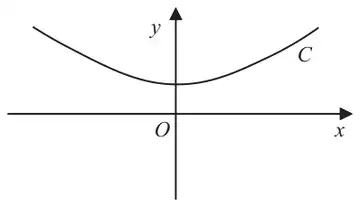
A solid playing piece for a board game is modelled by rotating the curve \(C\), shown in Figure 2, through \(2\pi\) radians about the \(x\)-axis.
The curve \(C\) has equation\[y = \sqrt{1 + \frac{x^2}{9}} \qquad -4 \leqslant x \leqslant 4\]with units as centimetres.
Using the substitution \(x = \dfrac{9}{\sqrt{10}}\sinh u\), or another algebraic integration method, and showing all your working,
| Scheme | Marks | AO |
|---|---|---|
| \[y = \sqrt{1 + \frac{x^2}{9}} \Rightarrow \frac{\mathrm{d}y}{\mathrm{d}x} = \frac{1}{2}\left(1 + \frac{x^2}{9}\right)^{-\frac{1}{2}} \times \frac{2x}{9} = \frac{x}{9}\left(1 + \frac{x^2}{9}\right)^{-\frac{1}{2}}\] | M1 A1 | 1.1b 1.1b |
| Surface of revolution\[S = 2\pi\int y\sqrt{1 + \left(\frac{\mathrm{d}y}{\mathrm{d}x}\right)^2}\,\mathrm{d}x = 2\pi\int \sqrt{1 + \frac{x^2}{9}}\sqrt{1 + \frac{x^2}{81}\left(1 + \frac{x^2}{9}\right)^{-1}}\,\mathrm{d}x\] | M1 | 2.1 |
| For example\[= 2\pi\int \frac{1}{3}\sqrt{9 + x^2}\sqrt{\frac{9(9 + x^2) + x^2}{9(9 + x^2)}}\,\mathrm{d}x = 2\pi\int \frac{1}{3}\cancel{\sqrt{9 + x^2}}\sqrt{\frac{81 + 10x^2}{9\cancel{(9 + x^2)}}}\,\mathrm{d}x\]Or\[= 2\pi\int \sqrt{1 + \frac{x^2}{9} + \frac{x^2}{81}}\,\mathrm{d}x = \frac{2\pi}{9}\int \sqrt{81 + 9x^2 + x^2}\,\mathrm{d}x\] | M1 | 1.1b |
| Circular end has area \(\pi \times y^2 = \pi\left(1 + \dfrac{16}{9}\right) = \dfrac{25\pi}{9}\) | B1 | 2.2a |
| \[\text{So } S = \frac{2\pi}{9}\int_{-4}^{4} \sqrt{81 + 10x^2}\,\mathrm{d}x + \frac{50\pi}{9}\] | A1 | 3.4 |
| (6) |
Notes
M1: Attempts to find \(\dfrac{\mathrm{d}y}{\mathrm{d}x}\) achieving the form \(Ax\left(1 + \dfrac{x^2}{9}\right)^{-\frac{1}{2}}\) oe
A1: Correct derivative.
M1: Uses the formula surface area \(= 2\pi\int y\sqrt{1 + \left(\dfrac{\mathrm{d}y}{\mathrm{d}x}\right)^2}\,\mathrm{d}x\)
M1: Manipulates the integral and simplifies to the given form.
B1: Correct area for a circular end found.
A1: Achieves the correct answer with no errors seen, including the limits from the model.
Alternative
| Scheme | Marks | AO |
|---|---|---|
| \[y^2 = 1 + \frac{x^2}{9} \Rightarrow 2y\frac{\mathrm{d}y}{\mathrm{d}x} = \frac{2}{9}x\] | M1 A1 | |
| Surface of revolution\[S = 2\pi\int y\sqrt{1 + \left(\frac{\mathrm{d}y}{\mathrm{d}x}\right)^2}\,\mathrm{d}x = 2\pi\int \sqrt{y^2 + \left(y\frac{\mathrm{d}y}{\mathrm{d}x}\right)^2}\,\mathrm{d}x\]\[= 2\pi\int \sqrt{1 + \frac{x^2}{9} + \left(\frac{x}{9}\right)^2}\,\mathrm{d}x\] | M1 | |
| \[= 2\pi\int \sqrt{1 + \frac{x^2}{9} + \frac{x^2}{81}}\,\mathrm{d}x = \frac{2\pi}{9}\int \sqrt{81 + 9x^2 + x^2}\,\mathrm{d}x\] | M1 | |
| Circular end has area \(\pi \times y^2 = \pi\left(1 + \dfrac{16}{9}\right) = \dfrac{25\pi}{9}\) | B1 | |
| \[\text{So } S = \frac{2\pi}{9}\int_{-4}^{4} \sqrt{81 + 10x^2}\,\mathrm{d}x + \frac{50\pi}{9}\] | A1 | |
| (6) |
M1: Find \(y^2\) and differentiates to the form \(2y\dfrac{\mathrm{d}y}{\mathrm{d}x} = Ax\)
A1: Correct derivative.
M1: Uses the formula surface area \(S = 2\pi\int y\sqrt{1 + \left(\dfrac{\mathrm{d}y}{\mathrm{d}x}\right)^2}\,\mathrm{d}x = 2\pi\int \sqrt{y^2 + \left(y\dfrac{\mathrm{d}y}{\mathrm{d}x}\right)^2}\,\mathrm{d}x\)
M1: Manipulates the integral and simplifies to the given form.
B1: Correct area for a circular end found.
A1: Achieves the correct answer with no errors seen, including the limits from the model.
| Scheme | Marks | AO |
|---|---|---|
| \[x = \frac{9}{\sqrt{10}}\sinh u \Rightarrow \frac{\mathrm{d}x}{\mathrm{d}u} = \frac{9}{\sqrt{10}}\cosh u\] | B1 | 1.1b |
| \[\text{So } S = \text{“}\frac{2}{9}\text{”}\pi\int \sqrt{81 + 81\sinh^2 u}\,\frac{9}{\sqrt{10}}\cosh u\,\mathrm{d}u\] | M1 | 2.1 |
| \[= B\pi\int \cosh^2 u\,\mathrm{d}u = B\pi\int \frac{1}{2}(\pm 1 \pm \cosh 2u)\,\mathrm{d}u\] | M1 | 1.1b |
| \[= \text{“}\frac{2}{9}\text{”} \times \frac{81\pi}{\sqrt{10}}\left[\frac{u}{2} + \frac{1}{4}\sinh 2u\right]\] | A1ft | 1.1b |
| So\[S = \frac{50\pi}{9} + \text{“}\frac{2}{9}\text{”} \times \frac{81\pi}{\sqrt{10}}\left[\begin{aligned} &\frac{1}{2}\operatorname{arsinh}\left(\frac{4\sqrt{10}}{9}\right) + \frac{1}{4}\sinh 2\operatorname{arsinh}\left(\frac{4\sqrt{10}}{9}\right) \\ &-\left(\frac{1}{2}\operatorname{arsinh}\left(\frac{-4\sqrt{10}}{9}\right) + \frac{1}{4}\sinh 2\operatorname{arsinh}\left(\frac{-4\sqrt{10}}{9}\right)\right) \end{aligned}\right] =\]\[S = \frac{50\pi}{9} + \text{“}\frac{2}{9}\text{”} \times \frac{81\pi}{\sqrt{10}}\big[(1.7827\ldots) - (-1.7827\ldots)\big] = \ldots\] | M1 | 3.4 |
| Surface area is awrt 81 (cm\(^2\)) | A1 | 1.1b |
| (6) | ||
| (12 marks) |
Notes
B1: Correct derivative statement connecting \(x\) and \(u\)
M1: Makes a full substitution to obtain an integral in terms of \(u\) only. No need for limits for this mark, and may use \(p\) or their \(p\) from (a)
M1: Simplifies and applies double angle formula of the form \(\cosh 2u = \pm 1 \pm 2\cosh^2 u\) to achieve an integral of the form \(B\pi\int \dfrac{1}{2}(\pm 1 \pm \cosh 2u)\,\mathrm{d}u\)
A1ft: For correct integration with their \(p\) from (a).
M1: Applies appropriate limits for their integral to find the surface area and adds the area of the ends. Either \(-4\) and 4 if returning to integral in terms of \(x\) (or 0 and 4 and doubling) or \(\operatorname{arsinh}\left(\dfrac{\pm 4\sqrt{10}}{9}\right)\) (or decimal approximation 1.14) if using \(u\). May be implied by a correct answer if explicit substitution not seen.
FYI the integral (without ends added) evaluates to 63.758…
A1: Correct surface area.
(corrected from the printed mark scheme: the double angle formula is printed as \(\cosh 2u = \pm 1 \pm \cosh^2 u\); the factor 2 is missing)